
Showing posts with label Phil Alberts. Show all posts
Showing posts with label Phil Alberts. Show all posts
Thursday, April 23, 2015
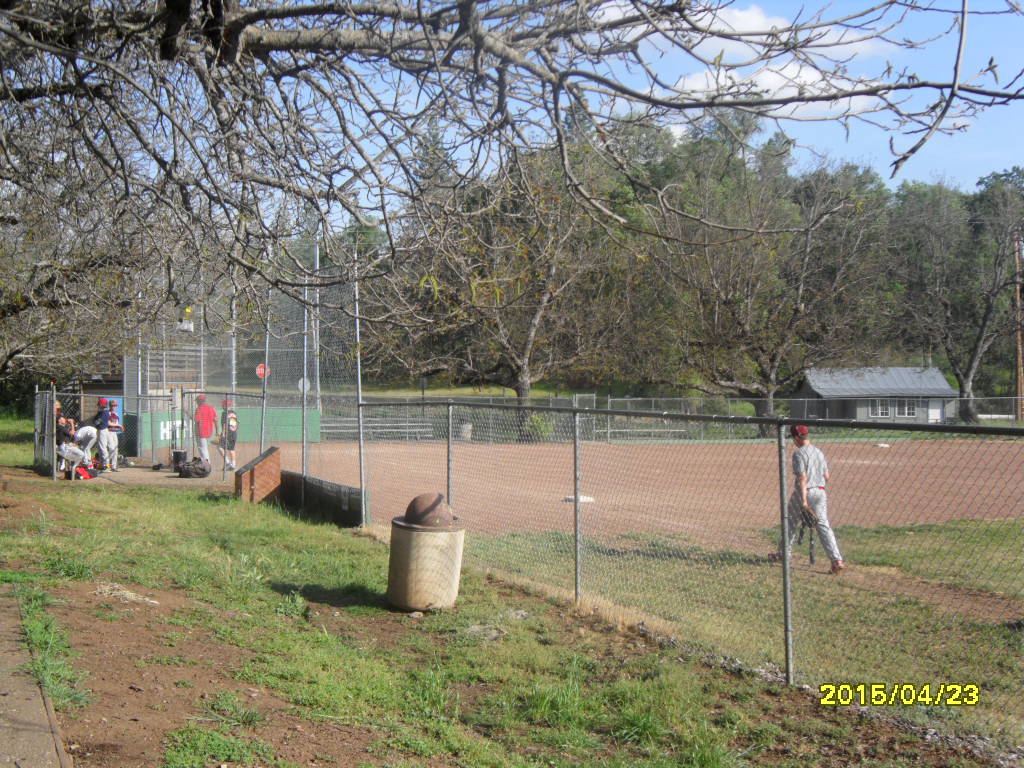
Mtn. Ranch Baseball Field
Lots of volunteers worked on the field this month. We cleaned the concession stand, by Linda O-Keefe, Phil Alberts, Mel Borges, Jerry Byrd. Pressure washed by Pete Connell, painted inside by Terry Crum, vent by Dan Dowdin, coordinated by Pete Connell. New Bases installed by Sam Smith and Phil Alberts. West Point Little League is using our field. Round-up weed killer around the field fence by Mel Borges. Outfield grass mowed by Bill Schmiett. Alan Senders and his crew assembled the batting cage purchased by donations so his team can practice. They are having a good season to date. Old flag destroyed by wind, a new one was ordered and has been installed. Adult softball will be starting soon.

Wednesday, April 15, 2015
The Clampers are Coming!! The Clampers are Coming!!

On June 13th the local MATUCA chapter of the E. Clampus Vitus will install an historical placque on the oldest building in Old El Dorado now known as Mountain Ranch.
The placque will read:
Domenghini Adobe
The Domenghini Adobe was built in 1856 by Mr. Pagani using adobe, field stones, and hand hewn beams. It is the oldest building in Mountain Ranch. In 1872 it was purchased by the Domenghini Family. This building was used as a saloon, pool hall and dance hall until 1901 when it was converted into a general store by brothers Attilio and Cash Domenghini and known as Domenghini Brothers General Merchandise. In 1925 it became known as the A. Domenghini and Son Store. In July 1965 the Domenghini property was purchased by the current owners, Phil D. Alberts and family,
Dedicated by:
E Clampus Vitus Matuca Chapter 1849
June 13th, 2015 (6020)
Credo Quia Absurdum
Clampology, an appendix,
Many Americans, especially those who left the ways of formal living, the frontiersmen and the 49'ers, abhorred false pretensions, or what might now be called "stuffed shirts". During the middle nineteenth century there was a steady development of organizations of fraternal orders under such names as the Sublime Knights, or the Grand Exalted Templars, etc. While these orders were organized to aid their members and often the unfortunates of their communities, still they affected elaborate uniforms, fancy dress swords and plumes and other such trappings. Their officers' titles, would by modern opinion, seem quite preposterous.
As a natural refutation of these, "spoofing" groups sprang up, usually, at least at first, informally organized. Probably the best known of these is the E. Clampus Vitus. When the first groups met is unknown. There are reports of Chapters in Bedford, Penn., in 1847, and in West Union, W. VA in 1850. Rumors of even earlier Chapters float around, but due to the tendency of all the Clamper writs to mix fact and fantasy, one never knows.
Such an order was a natural for those amusement-starved miners of the Mother Lode, and members from the States early formed ad hoc Chapters. The most current story is as follows:
A drummer would come to town and was asked, "Are you a Clamper?" As the salesman had never heard of E C.V., he was informed that all the merchants were Clampers and only bought from Clampers. After a reasonable time for the victim to check out this fact, they would relent and hold a special meeting to initiate the prospect. After initiation, some food and much liquor, the new member would be presented with the tab.
Just how many Clampers were organized is not known. There is a copy of the Initiation Manual of the Downieville Chapter in the Huntington Library, and Chapters were known to have been in existence until after 1880.
Many fables have come down of their activities. One that especially well tells of their feeling toward pretentiousness is that in the many parades in the mining towns after the elaborately uniformed Masonic orders, the various Knights and sundry Templars, a gang of red-shirted miners, giving the sign of the "well-Jackass", would march, led by their Noble Grand Humbug. Their standard-bearer would carry a tall pole supporting an ornate hoop skirt and slogan, "The Banner We Fought Under".
In our current time, a number of dedicated (if not always serious) historians decided to re-organize this Ancient and Noble Order. In the spring of 1930, Carl I. Wheat, George Ezra Dane and Leon Whitsell, the "Three Revivers", planned this revival. The first meeting was held at the Hotel Clift in "Yerba Buena" in 1931, with ten charter members. The first pilgrimage (later, called Clampouts) was to Downieville in May 1932, and there the first PBC, Ed Grabhorn, was initiated in front of the St. Charles Hotel Then came the first Annual Dinner, held at the Bohemian Club in Yerba Buena in January of 1933,
At first growth was slow, the second chapter being "Platrix, the Queen of Cow Counties." The first Clamper publication, "The Enigmatical Book of Vitus" came off in 1934.
The Articles of the Bylaws express the sublime indifference of the Order:
I. All Men are Officers
II. All Officers are of Equal Indignity
(It is rumored that the founding fathers became exhausted after giving birth to these immortal lines and repaired to a nearby tavern. They never recovered sufficiently to write an Article III, etc.)
Now, each Chapter meets twice a year in a Clampout, to initiate worthy though trembling PBC's and to dedicate a plaque at some little known -- though most worthy -- historical site. The Grand Council meets annually, the last weekend in May, at Murphy's Camp.
Satisfactory!!
And so recorded.
Monday, February 16, 2015
Baseball, Then and Now
In 1845 a New Yorker named Alexander Cartwright Jr. -- not Abner Doubleday -- invented the game that became America's pastime. Then he headed West taking with him a ball and bat.
Cartwright designed the game complete, bases at 90 feet in a diamond shape, players at each position with only 9 on each team. Bat in order with 3 outs, then exchange positions.
There had been many other games involving bases and balls before 1845 (some of them were even called baseball). A crudely defined game that was known as town ball, derived from the ancient English sport of rounders, had attained some popularity in New York and New England. (The New England version, with bases arranged in a U pattern and the batter's position entirely separate, was called the Massachusetts game.)
But all of these primitive exercises were static and aimless, and impossible to codify. Only after Cartwright's revolutionary innovations did the game ignite general excitement. Alexander Cartwright had invented baseball -- in the same sense that the Wright Brothers (and not Leonardo da Vinci) had invented the airplane, and Thomas A. Edison (and not Benjamin Franklin) had invented the electric light...
In the old days I guess every small town in America had a baseball team and Calaveras County was not to be outdone. Most every small, and some larger towns, especially the mining towns, all had their baseball team. Every team was in some sort of league. The foothill teams were called semi-professionals which meant they didn't get paid but they did have fun. And the town faithfully supported their team. Some say Mountain Ranch and Sheep Ranch teams couldn't win a game without their rooters. There was always a crowd to see the local boys play and when they played a rival team the rooters whistled, cheered, and rang the old dinner bell from the Sheep Ranch Hotel until the opponents were completely rattled.
There were very well organized teams at Mountain Ranch, Whiskey Slide, Murphys, Calaveritas, Sheep Ranch, RailRoad Flat, and West Point who played teams as far away as Sonora and the Stockton Pencil Factory. The Mountain Ranch - Sheep Ranch team were known as the best ball players in the league.
As early as the 1850's there was baseball in the Motherlode. Bill Denig who ran the Pony Express in Calaveras County played on the Calaveritas Team. Joe Reem the Eldorado Blacksmith also played. Also Red Greve the local grocer. The Rodesino Family had some boys who played on the El Dorado Team. John Walker played, J.F. Bench, a local merchant, also played. The population of old El Dorado was 200 in 1863.
In the 1920's and 30's those teams continued to produce some very good ball players. During the second world war the baseball idea fell to the wayside. But in the late 1940's and 50's it took off again with famous players like Yogi Berra, Ted Williams, Joe DiMaggio, Pee Wee Reese, Stan Musial, Micky Mantle and others. In 1947 Jackie Robinson was allowed to play Major League Ball. Just so you will know about "Babe" Ruth, in 1920 he had 497 home runs, 1365 runs, 1240 walks and 795 strike outs.
The more sporting gents of Calaveras County have been known to place a wager on any sporting event. Anyone who would bet on a frog jumping would certainly not hesitate to put his money on the line for his favorite baseball teams
In the 1880's Mark Bean from Sheep Ranch was the first pitcher to throw a curve ball in the Foothill League. He had batters jumping in every direction trying to get out of the way of the ball and hit it too. John Canavera, foreman of the Sheep Ranch Mine also played ball.
In the early spring when the baseball field at Sheep Ranch was covered with grain the team practiced at Rigney Flat, sometimes called Martin Flat. In Mtn. Ranch, the games were held on the Domenghini property behind the General Store.
Louis Domenghini, Paul Lewis, Clyde Cuslidge, Mr. Spiney, Charlie Valente and Warren Scott were the most faithful players. H.R. Platte, general manager of the Sheep Ranch mine donated the uniforms for the local teams. Mr. D. Fricot was a big supporter of all local sporting events.
Norbert Mudd played catcher for many years. The Umpire was Arthur Tisher who played on the team in the old days.
Before the automobile invaded the Mother Lode country the Sheep Ranch team used the big wagon to travel the many miles to neighboring towns. On the return trips from San Andreas the ball team always stopped at the Old Mountain Ranch Hotel to have supper which was served by Emma Fillippini.
Calaveras County developed a very active softball league which is still very active today.
Mtn. Ranch's first softball team was organized in 1980 after the local park and baseball field was built.
Jim Bennet, Jerry Howard and Phil Alberts put a team together that played West Point, Railroad Flat, Moke Hill, San Andreas and Valley Springs.
Through the years our local team has always been in the top three. One year we even took first place in the League.
Phil Alberts has continued to sponsor, play, coach and keep the team going. Sam Smith has been the manager and coach for many years and we are ready for the coming season. Come watch a game!
Cartwright designed the game complete, bases at 90 feet in a diamond shape, players at each position with only 9 on each team. Bat in order with 3 outs, then exchange positions.
There had been many other games involving bases and balls before 1845 (some of them were even called baseball). A crudely defined game that was known as town ball, derived from the ancient English sport of rounders, had attained some popularity in New York and New England. (The New England version, with bases arranged in a U pattern and the batter's position entirely separate, was called the Massachusetts game.)
But all of these primitive exercises were static and aimless, and impossible to codify. Only after Cartwright's revolutionary innovations did the game ignite general excitement. Alexander Cartwright had invented baseball -- in the same sense that the Wright Brothers (and not Leonardo da Vinci) had invented the airplane, and Thomas A. Edison (and not Benjamin Franklin) had invented the electric light...
In the old days I guess every small town in America had a baseball team and Calaveras County was not to be outdone. Most every small, and some larger towns, especially the mining towns, all had their baseball team. Every team was in some sort of league. The foothill teams were called semi-professionals which meant they didn't get paid but they did have fun. And the town faithfully supported their team. Some say Mountain Ranch and Sheep Ranch teams couldn't win a game without their rooters. There was always a crowd to see the local boys play and when they played a rival team the rooters whistled, cheered, and rang the old dinner bell from the Sheep Ranch Hotel until the opponents were completely rattled.
There were very well organized teams at Mountain Ranch, Whiskey Slide, Murphys, Calaveritas, Sheep Ranch, RailRoad Flat, and West Point who played teams as far away as Sonora and the Stockton Pencil Factory. The Mountain Ranch - Sheep Ranch team were known as the best ball players in the league.
As early as the 1850's there was baseball in the Motherlode. Bill Denig who ran the Pony Express in Calaveras County played on the Calaveritas Team. Joe Reem the Eldorado Blacksmith also played. Also Red Greve the local grocer. The Rodesino Family had some boys who played on the El Dorado Team. John Walker played, J.F. Bench, a local merchant, also played. The population of old El Dorado was 200 in 1863.
In the 1920's and 30's those teams continued to produce some very good ball players. During the second world war the baseball idea fell to the wayside. But in the late 1940's and 50's it took off again with famous players like Yogi Berra, Ted Williams, Joe DiMaggio, Pee Wee Reese, Stan Musial, Micky Mantle and others. In 1947 Jackie Robinson was allowed to play Major League Ball. Just so you will know about "Babe" Ruth, in 1920 he had 497 home runs, 1365 runs, 1240 walks and 795 strike outs.
The more sporting gents of Calaveras County have been known to place a wager on any sporting event. Anyone who would bet on a frog jumping would certainly not hesitate to put his money on the line for his favorite baseball teams
In the 1880's Mark Bean from Sheep Ranch was the first pitcher to throw a curve ball in the Foothill League. He had batters jumping in every direction trying to get out of the way of the ball and hit it too. John Canavera, foreman of the Sheep Ranch Mine also played ball.
In the early spring when the baseball field at Sheep Ranch was covered with grain the team practiced at Rigney Flat, sometimes called Martin Flat. In Mtn. Ranch, the games were held on the Domenghini property behind the General Store.
Louis Domenghini, Paul Lewis, Clyde Cuslidge, Mr. Spiney, Charlie Valente and Warren Scott were the most faithful players. H.R. Platte, general manager of the Sheep Ranch mine donated the uniforms for the local teams. Mr. D. Fricot was a big supporter of all local sporting events.
Norbert Mudd played catcher for many years. The Umpire was Arthur Tisher who played on the team in the old days.
Before the automobile invaded the Mother Lode country the Sheep Ranch team used the big wagon to travel the many miles to neighboring towns. On the return trips from San Andreas the ball team always stopped at the Old Mountain Ranch Hotel to have supper which was served by Emma Fillippini.
Calaveras County developed a very active softball league which is still very active today.
Mtn. Ranch's first softball team was organized in 1980 after the local park and baseball field was built.
Jim Bennet, Jerry Howard and Phil Alberts put a team together that played West Point, Railroad Flat, Moke Hill, San Andreas and Valley Springs.
Through the years our local team has always been in the top three. One year we even took first place in the League.
Phil Alberts has continued to sponsor, play, coach and keep the team going. Sam Smith has been the manager and coach for many years and we are ready for the coming season. Come watch a game!
Sunday, December 7, 2014
We Remember Her

Her name was Emma and she died earlier this year giving birth to the most beautiful colt you ever saw.
The foal is named Emmitt, doing just fine, but we will miss his mother. That big draft mare who so gently gave all who knew her great pleasure.
THANKS to Curt Morefield for introducing Mtn. Ranch to this beautiful lady. We will miss her.

Wednesday, October 15, 2014
The Domenghini Family of Calaveras County
Luigi and Caroline Domenghini came to Calaveras County in the early 1870‘s with one son, Attilio, who was born in Switzerland in January 1868. They came by ship, the crowded old ships that caused the death of many a fearless traveler. They crossed this great country of ours by wagon train with hardships beyond the imagination of modern man.
In Calaveras County they picked the quiet and peaceful valley near Murray Creek to settle down and work the land as the good Lord had intended man to do.
Two more boys were born near Mountain Ranch, Cash in 1878 and Charles a year later, who died in infancy. Big strong boys were what every farmer looked for in his family, they were needed so a family could make a living from the land.
Luigi purchased a large piece of land in Mountain Ranch in 1872 and ran a saloon in the stone building built by Mr. Pagani in 1856. Luigi Domenghini was born in 1844 and died in 1891 at 46 years of age. His wife died in 1935 and both are buried in Mountain Ranch Cemetery.
Through the years the Domenghini family purchased more land in the Mountain Ranch area and at one time owned what is now called the M-24 Ranch and also Hidden Valley. As the years went by this land was sold piece-by-piece.
Cash Domenghini married Elba Ames in 1919. They had no children. Cash died in 1925 and is also buried in the Mountain Ranch Cemetery.
The present Domenghini Building was a saloon until 1901 when the Domenghini Brothers remodeled the interior and opened a general store ater one year in the Domenghini Building. Supplies were picked up at Valley Springs by team and wagon from the railroad. These trips took two or three days. Drummers also made the round to the mountain communities.
Attilio married Clorinda Valente from Sheep Ranch after a whirlwind courtship. They became acquainted at a dance in Mountain Ranch. They were married in Clorinda’s home by a priest from Angel’s Camp in January 1901. The wedding was delayed one month because the house Attilio was building in Mountain Ranch was not finished. Clorinda said No House, No Wedding! During this delay in the wedding plans Clorinda continued to work at their boarding house at Indian Creek to supply meals to the workers for the large electrical project going in near Angels Camp.
Their honeymoon was spent in San Jose and San Francisco. They traveled from Indian Creek, near Sheep Ranch, by a two-horse buggy to catch the train at Milton.
Clorinda still lived in the same house, next to the general store, that she moved into on her wedding day, until late 1966 She used the same bedroom set, wood cook stove, chairs and cabinets. The wallpaper was the original and the home was truly a step into the past.
Attilio Domenghini was on the Calaveras County Board of Supervisors in the early 1930‘s.
A son was born on Dec. 4th, 1901. Louis was an only child. He went to school in Mountain Ranch to the 9th grade He was an excellent student and excelled in sports. After graduation he went to Herald’s Business College in Stockton until his uncle Cash became ill. Then he returned home to help his father with the business.
Louis married Edyth Roe on Feb. 28th, 1925 at Stockton. They lived on the Roe Ranch just north of town until Oct. 1938 when they moved into Mountain Ranch. No children were born of this marriage. Louis died May 31, 1963. When he died it was felt throughout Calaveras County. He was a man without an enemy.
Domenghini General Store Building
Built in 1856 by a man named Pagani, this is the oldest building in Mountain Ranch. Constructed of stone, adobe and hand-hewn beams with a full basement, this old building has withstood time and tribulations with very little sign of stress. Material was dug from Adobe Gulch just south of town.
The 24-inch stone wall, iron shutters on the windows and doors, wooden plank floor and high ceiling make this one of the true marvels of the Mother Lode. There are glass windows inlaid in the floor about six inches square to give light to the basement. The large hooks for lowering heavy items into the basement are still visible.
It was purchased by the Domenghini family in 1872. This building was used as a saloon, pool hall and dance hall until 1901. The Domenghini brothers remodeled the interior into a general store in late 1901. It has been in continuous use ever since. The house next to the store burned down and was rebuilt in 1905. This same house was moved across the street in 1938 and is still in use today.
This business was known as Domenghini Brothers General Merchandise until Cash Domenghini’s death in 1925. Then Louis Domenghini, son of Attilio and Clorinda Domenghini, came home from business college to help his dad with the store operation. It became known as A. Domenghini and Son from that day on. With Attilio’s death in 1952 his son Louis continued to operate the general store under that name.
After Louis died in 1963 his widow continued the business under the faithful management of Francis Devoto who had worked for the Domenghinis for some thirty-odd years.
The business, buildings and Domenghini property was then sold in July 1965 to Phil O. Alberts and family. They have donated all of the old store fixtures and some merchandise that has survived all these years and now is on display at the Red Barn Museum.
The round glass candy case, McCaskeg charge account register, old scales, coffee grinder, tobacco cutter, old photos and so much more. Stop by and see this and all the other displays at the Museum.
Clorinda’s Family History
Genoa, Italy, is the place of departure for Mrs. Clorinda Domenghini’s mother in 1862. Janie Cuneo, Clorinda’s mother, was born in Plan De Cunei Turri, Italy, a suburb of Genoa. In her younger years she set off from Genoa to America in search of her two brothers. The brothers were mining around the San Antone Camp. After Janie had reached her destination, she set up housekeeping for the boys. A year after she arrived, in 1863, she married Angelo Canavera. After they were married they moved to Esmeralda and there they established a store. Then Janie gave birth to two boys, John and Henry. A few years after they had been married, Angelo died as the results of an accident. After her first husband’s death she married Steve Valente. At this time they moved to Indian Creek. This was a little mining community about three miles from Sheep Ranch and approximately five miles from Murphys road. After moving to Indian Creek Mr. Valente built a little store. It was not too long before the mines closed down and when they did the Valentes lived on their ranch. During the cold winters to follow the Valentes kept boarders that would occasionally work in the mines. Clorinda’s sister Mary lived in this house her whole life; it was burned down in the Old Gulch Fire.
Clorinda’s Youth
When the mines opened again the Valentes kept the boarding house to hep support the new addition to the family. This addition came in 1879 which was Clorinda.
There was not much going on in Clorinda’s life until she started school. She just had the usual chores boys and girls had at that time. Clorinda and her two half-brothers, John and Henry Canavera, and sister Mary would attend school in Sheep Ranch. At this time Sheep Ranch had quite a few people. The school at which they attended had two rooms. There were over a hundred students that went to this two room school. Clorinda, John and Henry would walk three miles on nothing but a cow trail. On their way to school they had to cross San Antone Creek on a log bridge. They never had to worry about the bus being late or if it was going to run. They just hoped that the bridge would not wash out. The bridge did wash out a few times. When it did this would cause them to miss school for several weeks before it would be repaired. They would come home from school by walking or hitch a ride on wagons driven by wood choppers or vegetable men, leaving from Sheep Ranch Mine. One person that they rode with had his wagon pulled by an oxen team.
There were other incidents that would happen to Clorinda and her brothers also. Several times, a wood chopper, who would cut wood for the mine, would stop them on the trail and ask them to get a few items in town for them. These items were tobacco and matches. When school let out Clorinda would take the items she got for the men and leave them on a certain stump that had a dime or some reward left for this little task. She attended school up to the fifth grade. Then her mother became ill and she was needed at home so had to quit school. From this time on she stayed at home and worked on the ranch at Indian Creek.
On January 10, 1950, Clorinda and Attilio celebrated their 50th wedding anniversary. And two short years later Attilio died on January 17th, 1952, just before his 84th birthday. After Louis’ father died he took over the store. And after 11 more years the Domenghini family suffered another death in the family. This time it happened to Louis. He died May 31, After Louis’ death Clorinda passed away a few years later in San Andreas. The last of the gracious ladies of Mountain Ranch.
In Calaveras County they picked the quiet and peaceful valley near Murray Creek to settle down and work the land as the good Lord had intended man to do.
Two more boys were born near Mountain Ranch, Cash in 1878 and Charles a year later, who died in infancy. Big strong boys were what every farmer looked for in his family, they were needed so a family could make a living from the land.
Luigi purchased a large piece of land in Mountain Ranch in 1872 and ran a saloon in the stone building built by Mr. Pagani in 1856. Luigi Domenghini was born in 1844 and died in 1891 at 46 years of age. His wife died in 1935 and both are buried in Mountain Ranch Cemetery.
Through the years the Domenghini family purchased more land in the Mountain Ranch area and at one time owned what is now called the M-24 Ranch and also Hidden Valley. As the years went by this land was sold piece-by-piece.
Cash Domenghini married Elba Ames in 1919. They had no children. Cash died in 1925 and is also buried in the Mountain Ranch Cemetery.
The present Domenghini Building was a saloon until 1901 when the Domenghini Brothers remodeled the interior and opened a general store ater one year in the Domenghini Building. Supplies were picked up at Valley Springs by team and wagon from the railroad. These trips took two or three days. Drummers also made the round to the mountain communities.
Attilio married Clorinda Valente from Sheep Ranch after a whirlwind courtship. They became acquainted at a dance in Mountain Ranch. They were married in Clorinda’s home by a priest from Angel’s Camp in January 1901. The wedding was delayed one month because the house Attilio was building in Mountain Ranch was not finished. Clorinda said No House, No Wedding! During this delay in the wedding plans Clorinda continued to work at their boarding house at Indian Creek to supply meals to the workers for the large electrical project going in near Angels Camp.
Their honeymoon was spent in San Jose and San Francisco. They traveled from Indian Creek, near Sheep Ranch, by a two-horse buggy to catch the train at Milton.
Clorinda still lived in the same house, next to the general store, that she moved into on her wedding day, until late 1966 She used the same bedroom set, wood cook stove, chairs and cabinets. The wallpaper was the original and the home was truly a step into the past.
Attilio Domenghini was on the Calaveras County Board of Supervisors in the early 1930‘s.
A son was born on Dec. 4th, 1901. Louis was an only child. He went to school in Mountain Ranch to the 9th grade He was an excellent student and excelled in sports. After graduation he went to Herald’s Business College in Stockton until his uncle Cash became ill. Then he returned home to help his father with the business.
Louis married Edyth Roe on Feb. 28th, 1925 at Stockton. They lived on the Roe Ranch just north of town until Oct. 1938 when they moved into Mountain Ranch. No children were born of this marriage. Louis died May 31, 1963. When he died it was felt throughout Calaveras County. He was a man without an enemy.
Domenghini General Store Building
Built in 1856 by a man named Pagani, this is the oldest building in Mountain Ranch. Constructed of stone, adobe and hand-hewn beams with a full basement, this old building has withstood time and tribulations with very little sign of stress. Material was dug from Adobe Gulch just south of town.
The 24-inch stone wall, iron shutters on the windows and doors, wooden plank floor and high ceiling make this one of the true marvels of the Mother Lode. There are glass windows inlaid in the floor about six inches square to give light to the basement. The large hooks for lowering heavy items into the basement are still visible.
It was purchased by the Domenghini family in 1872. This building was used as a saloon, pool hall and dance hall until 1901. The Domenghini brothers remodeled the interior into a general store in late 1901. It has been in continuous use ever since. The house next to the store burned down and was rebuilt in 1905. This same house was moved across the street in 1938 and is still in use today.
This business was known as Domenghini Brothers General Merchandise until Cash Domenghini’s death in 1925. Then Louis Domenghini, son of Attilio and Clorinda Domenghini, came home from business college to help his dad with the store operation. It became known as A. Domenghini and Son from that day on. With Attilio’s death in 1952 his son Louis continued to operate the general store under that name.
After Louis died in 1963 his widow continued the business under the faithful management of Francis Devoto who had worked for the Domenghinis for some thirty-odd years.
The business, buildings and Domenghini property was then sold in July 1965 to Phil O. Alberts and family. They have donated all of the old store fixtures and some merchandise that has survived all these years and now is on display at the Red Barn Museum.
The round glass candy case, McCaskeg charge account register, old scales, coffee grinder, tobacco cutter, old photos and so much more. Stop by and see this and all the other displays at the Museum.
Clorinda’s Family History
Genoa, Italy, is the place of departure for Mrs. Clorinda Domenghini’s mother in 1862. Janie Cuneo, Clorinda’s mother, was born in Plan De Cunei Turri, Italy, a suburb of Genoa. In her younger years she set off from Genoa to America in search of her two brothers. The brothers were mining around the San Antone Camp. After Janie had reached her destination, she set up housekeeping for the boys. A year after she arrived, in 1863, she married Angelo Canavera. After they were married they moved to Esmeralda and there they established a store. Then Janie gave birth to two boys, John and Henry. A few years after they had been married, Angelo died as the results of an accident. After her first husband’s death she married Steve Valente. At this time they moved to Indian Creek. This was a little mining community about three miles from Sheep Ranch and approximately five miles from Murphys road. After moving to Indian Creek Mr. Valente built a little store. It was not too long before the mines closed down and when they did the Valentes lived on their ranch. During the cold winters to follow the Valentes kept boarders that would occasionally work in the mines. Clorinda’s sister Mary lived in this house her whole life; it was burned down in the Old Gulch Fire.
Clorinda’s Youth
When the mines opened again the Valentes kept the boarding house to hep support the new addition to the family. This addition came in 1879 which was Clorinda.
There was not much going on in Clorinda’s life until she started school. She just had the usual chores boys and girls had at that time. Clorinda and her two half-brothers, John and Henry Canavera, and sister Mary would attend school in Sheep Ranch. At this time Sheep Ranch had quite a few people. The school at which they attended had two rooms. There were over a hundred students that went to this two room school. Clorinda, John and Henry would walk three miles on nothing but a cow trail. On their way to school they had to cross San Antone Creek on a log bridge. They never had to worry about the bus being late or if it was going to run. They just hoped that the bridge would not wash out. The bridge did wash out a few times. When it did this would cause them to miss school for several weeks before it would be repaired. They would come home from school by walking or hitch a ride on wagons driven by wood choppers or vegetable men, leaving from Sheep Ranch Mine. One person that they rode with had his wagon pulled by an oxen team.
There were other incidents that would happen to Clorinda and her brothers also. Several times, a wood chopper, who would cut wood for the mine, would stop them on the trail and ask them to get a few items in town for them. These items were tobacco and matches. When school let out Clorinda would take the items she got for the men and leave them on a certain stump that had a dime or some reward left for this little task. She attended school up to the fifth grade. Then her mother became ill and she was needed at home so had to quit school. From this time on she stayed at home and worked on the ranch at Indian Creek.
On January 10, 1950, Clorinda and Attilio celebrated their 50th wedding anniversary. And two short years later Attilio died on January 17th, 1952, just before his 84th birthday. After Louis’ father died he took over the store. And after 11 more years the Domenghini family suffered another death in the family. This time it happened to Louis. He died May 31, After Louis’ death Clorinda passed away a few years later in San Andreas. The last of the gracious ladies of Mountain Ranch.
Tuesday, July 15, 2014
Little League Season
Our season has ended with a great job by both teams and their coaches.
Mike Sabelberg, E. Naski and Brian Fuller had a busy season getting all their rookies ready for baseball. Everyone had a great year and learned a lot about the game.
Allen Sender, Will Glover and Ole Gardina took their team to the sectionals in Tracy for a real baseball education, Great Year!!
We want to also thank those special people who donated to the Little League because this year the Park Committee and the Community Club told us there were no funds available this year like there has been for the past 30 years.
Special mention to Allen Sender and Phil Alberts for large donations to help buy the batting cage and other equipment.

We also want to thank:
Chuck and Linda Turner,
Bob Croft of Pumpco,
San Andreas Print Shop,
MRYA Resource Center,
and all those other volunteers for a great year.
Mike Sabelberg, E. Naski and Brian Fuller had a busy season getting all their rookies ready for baseball. Everyone had a great year and learned a lot about the game.
Allen Sender, Will Glover and Ole Gardina took their team to the sectionals in Tracy for a real baseball education, Great Year!!
We want to also thank those special people who donated to the Little League because this year the Park Committee and the Community Club told us there were no funds available this year like there has been for the past 30 years.
Special mention to Allen Sender and Phil Alberts for large donations to help buy the batting cage and other equipment.
We also want to thank:
Chuck and Linda Turner,
Bob Croft of Pumpco,
San Andreas Print Shop,
MRYA Resource Center,
and all those other volunteers for a great year.
Monday, July 14, 2014
Outlaws of El Dorado
The most famous dirty deed of note locally was the attempted stage hold-up and murder on Mountain Ranch Road in April of 1892 where 15 year old Johanna Rodesino was killed. She is buried in Mountain Ranch. No treasure was taken and the bandit was never apprehended.
In Dec. of 1864 a Chinaman stabbed a storekeeper in Cave City and he was brought to El Dorado after his capture. The storekeeper died so the good people of El Dorado hung the Chinaman. It is believed the huge oak tree across from the Blunder Inn is that tree.
In 1883 that iron-willed lawman of Calaveras County played a prominent role in the manhunt for Charles E. Boles, alias Black Bart. Ben Thorn’s first law job was in the spring of 1853 when he helped search for Joaquin Murrieta. Joaquin spent time in old El Dorado getting supplies, especially from the bakery operated by Julin Paterey which was located behind the present candle shop.
Ben was involved in the capture of long hair Sam Brown in 1855 which started in Upper Calaveritas and ended on O’Neil Creek.
Ben Thorn died on Nov. 15th, 1905 and was a law officer in Calaveras County for 50 years. His home still stands in San Andreas today.
In 1851 at Whiskey Slide, just north of Mountain Ranch, a miner was found murdered in his cabin one morning. The whole place had been ransacked. Fifteen years later another miner came and built a new cabin on the hill. He heard from a dying companion that the murdered man had hidden his treasures under the floor of the cabin.
The man who built the second cabin finally found the gold over $10,000 worth... but then became obsessed by the idea that the gold was haunted. At last, in terror he reburied it, shortly after telling his story he went mad and was confined in the Stockton Asylum, where he died. No one has ever reported finding this hidden treasure. Another tale of the Gold Rush days that lies buried forever.
The San Andreas Independent of Dec. 4, 1858, tells of a desperate fight at El Dorado in which two Americans were killed. Two Mexicans escaped but the third was captured. He was later freed for want of sufficient testimony. The Mexicans did not live in El Dorado. Because of early racial problems with the Mexicans in San Andreas, very few were ever known to live and work near El Dorado or Mountain Ranch.
As early as 1849 Ned Bushyhead, born in the Cherokee Nation, was the constable of El Dorado Mining District. Before 1849 El Dorado Camp was a gathering place for individuals looking to get away from the law. These were just rough and tumble gentlemen who did not want to tow the line when it came to community betterment ideas.
There were many law abiding citizens in El Dorado so as a complete community we were pretty safe. The Zwinge family was involved in law enforcement for a couple generations.
So if you are lucky enough to live in Mountain Ranch, then you are lucky enough.
In Dec. of 1864 a Chinaman stabbed a storekeeper in Cave City and he was brought to El Dorado after his capture. The storekeeper died so the good people of El Dorado hung the Chinaman. It is believed the huge oak tree across from the Blunder Inn is that tree.
In 1883 that iron-willed lawman of Calaveras County played a prominent role in the manhunt for Charles E. Boles, alias Black Bart. Ben Thorn’s first law job was in the spring of 1853 when he helped search for Joaquin Murrieta. Joaquin spent time in old El Dorado getting supplies, especially from the bakery operated by Julin Paterey which was located behind the present candle shop.
Ben was involved in the capture of long hair Sam Brown in 1855 which started in Upper Calaveritas and ended on O’Neil Creek.
Ben Thorn died on Nov. 15th, 1905 and was a law officer in Calaveras County for 50 years. His home still stands in San Andreas today.
In 1851 at Whiskey Slide, just north of Mountain Ranch, a miner was found murdered in his cabin one morning. The whole place had been ransacked. Fifteen years later another miner came and built a new cabin on the hill. He heard from a dying companion that the murdered man had hidden his treasures under the floor of the cabin.
The man who built the second cabin finally found the gold over $10,000 worth... but then became obsessed by the idea that the gold was haunted. At last, in terror he reburied it, shortly after telling his story he went mad and was confined in the Stockton Asylum, where he died. No one has ever reported finding this hidden treasure. Another tale of the Gold Rush days that lies buried forever.
The San Andreas Independent of Dec. 4, 1858, tells of a desperate fight at El Dorado in which two Americans were killed. Two Mexicans escaped but the third was captured. He was later freed for want of sufficient testimony. The Mexicans did not live in El Dorado. Because of early racial problems with the Mexicans in San Andreas, very few were ever known to live and work near El Dorado or Mountain Ranch.
As early as 1849 Ned Bushyhead, born in the Cherokee Nation, was the constable of El Dorado Mining District. Before 1849 El Dorado Camp was a gathering place for individuals looking to get away from the law. These were just rough and tumble gentlemen who did not want to tow the line when it came to community betterment ideas.
There were many law abiding citizens in El Dorado so as a complete community we were pretty safe. The Zwinge family was involved in law enforcement for a couple generations.
So if you are lucky enough to live in Mountain Ranch, then you are lucky enough.
Our Mens Team
To keep the Mountain Ranch Mens Softball Team in good shape for the coming season we called Sonora to see if we could play in their spring season. We thought this would be just the thing to get our team all tuned up.
Sonora said, “Sure, come over”, and they would teach the hillbilly Mountain Ranch how to play softball. So Sam Smith the manager and coach took Alberts’ Hitmen to Sonora.
So Alberts’ Hitmen, the Mountain Ranch slow pitch softball team, travels 46 miles to Sonora, CA, to play in Standard Parks Spring Rec League every Thursday night. The Hitmen started out this league undefeated until they faced “Make a Mends” who gave Hitmen their first loss, winning by one run, making Hitmen 5-1. The Hitmen went on to face “Maynard’s” the next Thursday getting beat by 8 runs which gave them their first real upset. This gave both teams a 7-2 record going into playoffs. When the record is the same going into playoffs it is down to counting runs to decide seeding. Maynard’s came out with 7 more runs, making then the 1st seed team and Hitmen 2nd seed.
June 12th marked the day for the playoffs for this Spring League and Championship game to follow. 1st seed to play 4th seed, and 2nd seed to play 3rd. Hitmen were to face SVP at 6:30 to be the first playoff game of the night. SVP was forced to forfeit because Standard Park rule is each team has 10 min. after original game to take the field, so lack of players by set time caused a forfeit. Therefore, the Hitmen moved on to the championship slot with an 8-2 record.
Maynard’s and Hitmen started this championship game battling from the very first inning trading leads throughout the first half of this game. Each team is allotted 7 home runs per game, and both teams hit 4 of the 7, until the Hitmen cam out banging in the 5th inning, blowing out 15 runs, going through their line-up twice, giving them the biggest lead of the game. The Hitmen are able to hold down Maynard’s, maintaining an 8 run lead to win the championship and making this game 2 hours long. This was an intense game filled with skill, dedication and competition from both teams. With a high scoring game like this you can tell winning the championship
didn’t come very easily for the Hitmen.
Sonora said, “Sure, come over”, and they would teach the hillbilly Mountain Ranch how to play softball. So Sam Smith the manager and coach took Alberts’ Hitmen to Sonora.
So Alberts’ Hitmen, the Mountain Ranch slow pitch softball team, travels 46 miles to Sonora, CA, to play in Standard Parks Spring Rec League every Thursday night. The Hitmen started out this league undefeated until they faced “Make a Mends” who gave Hitmen their first loss, winning by one run, making Hitmen 5-1. The Hitmen went on to face “Maynard’s” the next Thursday getting beat by 8 runs which gave them their first real upset. This gave both teams a 7-2 record going into playoffs. When the record is the same going into playoffs it is down to counting runs to decide seeding. Maynard’s came out with 7 more runs, making then the 1st seed team and Hitmen 2nd seed.
June 12th marked the day for the playoffs for this Spring League and Championship game to follow. 1st seed to play 4th seed, and 2nd seed to play 3rd. Hitmen were to face SVP at 6:30 to be the first playoff game of the night. SVP was forced to forfeit because Standard Park rule is each team has 10 min. after original game to take the field, so lack of players by set time caused a forfeit. Therefore, the Hitmen moved on to the championship slot with an 8-2 record.
Maynard’s and Hitmen started this championship game battling from the very first inning trading leads throughout the first half of this game. Each team is allotted 7 home runs per game, and both teams hit 4 of the 7, until the Hitmen cam out banging in the 5th inning, blowing out 15 runs, going through their line-up twice, giving them the biggest lead of the game. The Hitmen are able to hold down Maynard’s, maintaining an 8 run lead to win the championship and making this game 2 hours long. This was an intense game filled with skill, dedication and competition from both teams. With a high scoring game like this you can tell winning the championship
didn’t come very easily for the Hitmen.
The 156th Anniversary of our Post Office
The first post office in this area of Calaveras County was at Double Springs in 1851. This building was shipped over here from China made of camphor wood. It also was the first court house of Calaveras County. The building has been restored at the museum in San Andreas. Later that same year Moke Hill opened their post office.
Third Crossing opened in 1852 followed by San Andreas in 1854.
Fourth Crossing in 1855 and closer to home was Mill Valley which was located on Whiskey Slide Road where it crosses Jesus Maria Creek. locals have known this as the Sharp Ranch.
Railroad Flat opened in 1857 and Mountain Ranch in 1858. Also Poverty Flat in 1858 which was north of town.
Sheep ranch in 1877, Glencoe in 1878 and Cave City in 1883. As you can see a great many of these post offices opened with the discovery of a good gold claim, opened very quickly and died just as fast. Only 5 of the 12 locations are still in operation.
Things changed very quickly in the early gold rush days as you can see.
The first post office in Mountain Ranch, which was located one mile north of the present town of Mountain Ranch, was established on July 30th, 1858. John McKeon was the first postmaster. The net proceeds for 1858 were $2.33. Mr. McKeon’s compensation was $7.31. A profitable first year? William H. Holmes became postmaster on July 29th, 1861.
In 1868 the post office was moved from Mountain Ranch to El Dorado. They could not name this post office El Dorado because there already was a post office with this name in El Dorado County, so the name Mountain Ranch was moved with the post office.
With this move old Mountain Ranch again became a private residence and a ranch and the town of El Dorado then became known as Mountain Ranch.
Bartalmo Dughi became postmaster on July 6, 1868. The Dughi building is now a private residence where Judy and Frank Brockman live, considered by most historians as one of the finest buildings still in use in the Mother Lode. Giovanni Rodesino was postmaster on Nov. 20, 1888. This was in the two story building that later became Senders Market which burned down on Christmas morning in 1968. The new Senders Market is located on the same spot.
The post office was then in Joe Devoto’s home and he became postmaster on May 25, 1894. His house was next to the Dughi building and it still stands today as the Lutheran Church. This half house, sometimes called a Flounder house, is the oldest wooden building in Mountain Ranch.
Mrs. Jennie Devoto Koen, Joe’s sister, then became postmaster on Jan. 22, 1906. As a clerk and postmaster she worked for the department for 27 years. Mrs. Koen died March 27, 1967 at the age of 94.
A small eight-by-ten-foot building was built April 5th, 1923 by James Javeaux and John Zwinge from lumber purchased from Fred Leidecker of Mountain Ranch. This building was built at the corner of Garabaldi and Washington Streets. May E. Javeaux was postmaster here in the world’s smallest post office from March 2, 1923 until Feb. 6th, 1956. Mrs. Javeaux then retired after 33 years of service.
Today you can see the world’s smallest post office on display here in town.
In a story published in the Washington D.C. Star, it was stated that May E. Javeaux claimed that the office served 250 patrons and was the smallest in the country. No challengers to the title ever disputed this claim.
On Dec. 22, 1956, last-day cancellations were made in the historic “toy-like” post office.
Virginia Butterfield became postmaster in the new enlarged building on Feb. 6th 1956. This building is also on display next to the world’s smallest post office on Washington Street in downtown Mountain Ranch.
In 1982 the new enlarged post office was built to accommodate the population increase plus the closing of the Sheep Ranch post office.
Luellan Del Papa was the post master at that time and there has been a series of post masters ever since.
Luellan retired in 1990 and will be remembered as the last of the old time public servants. Over 300 people attended her retirement party at the Mountain Ranch Park.
Wally Matlock has put together a very interesting display of the story of post offices in Calaveras County which is at the Mountain Ranch Post Office for your viewing pleasure. We now have 5 buildings on Washington Street in Mountain Ranch that are or have been a Post Office and one building that no longer exists. We believe there is not another town in CA that can make that claim.
Third Crossing opened in 1852 followed by San Andreas in 1854.
Fourth Crossing in 1855 and closer to home was Mill Valley which was located on Whiskey Slide Road where it crosses Jesus Maria Creek. locals have known this as the Sharp Ranch.
Railroad Flat opened in 1857 and Mountain Ranch in 1858. Also Poverty Flat in 1858 which was north of town.
Sheep ranch in 1877, Glencoe in 1878 and Cave City in 1883. As you can see a great many of these post offices opened with the discovery of a good gold claim, opened very quickly and died just as fast. Only 5 of the 12 locations are still in operation.
Things changed very quickly in the early gold rush days as you can see.
The first post office in Mountain Ranch, which was located one mile north of the present town of Mountain Ranch, was established on July 30th, 1858. John McKeon was the first postmaster. The net proceeds for 1858 were $2.33. Mr. McKeon’s compensation was $7.31. A profitable first year? William H. Holmes became postmaster on July 29th, 1861.
In 1868 the post office was moved from Mountain Ranch to El Dorado. They could not name this post office El Dorado because there already was a post office with this name in El Dorado County, so the name Mountain Ranch was moved with the post office.
With this move old Mountain Ranch again became a private residence and a ranch and the town of El Dorado then became known as Mountain Ranch.
Bartalmo Dughi became postmaster on July 6, 1868. The Dughi building is now a private residence where Judy and Frank Brockman live, considered by most historians as one of the finest buildings still in use in the Mother Lode. Giovanni Rodesino was postmaster on Nov. 20, 1888. This was in the two story building that later became Senders Market which burned down on Christmas morning in 1968. The new Senders Market is located on the same spot.
The post office was then in Joe Devoto’s home and he became postmaster on May 25, 1894. His house was next to the Dughi building and it still stands today as the Lutheran Church. This half house, sometimes called a Flounder house, is the oldest wooden building in Mountain Ranch.
Mrs. Jennie Devoto Koen, Joe’s sister, then became postmaster on Jan. 22, 1906. As a clerk and postmaster she worked for the department for 27 years. Mrs. Koen died March 27, 1967 at the age of 94.
A small eight-by-ten-foot building was built April 5th, 1923 by James Javeaux and John Zwinge from lumber purchased from Fred Leidecker of Mountain Ranch. This building was built at the corner of Garabaldi and Washington Streets. May E. Javeaux was postmaster here in the world’s smallest post office from March 2, 1923 until Feb. 6th, 1956. Mrs. Javeaux then retired after 33 years of service.
Today you can see the world’s smallest post office on display here in town.
In a story published in the Washington D.C. Star, it was stated that May E. Javeaux claimed that the office served 250 patrons and was the smallest in the country. No challengers to the title ever disputed this claim.
On Dec. 22, 1956, last-day cancellations were made in the historic “toy-like” post office.
Virginia Butterfield became postmaster in the new enlarged building on Feb. 6th 1956. This building is also on display next to the world’s smallest post office on Washington Street in downtown Mountain Ranch.
In 1982 the new enlarged post office was built to accommodate the population increase plus the closing of the Sheep Ranch post office.
Luellan Del Papa was the post master at that time and there has been a series of post masters ever since.
Luellan retired in 1990 and will be remembered as the last of the old time public servants. Over 300 people attended her retirement party at the Mountain Ranch Park.
Wally Matlock has put together a very interesting display of the story of post offices in Calaveras County which is at the Mountain Ranch Post Office for your viewing pleasure. We now have 5 buildings on Washington Street in Mountain Ranch that are or have been a Post Office and one building that no longer exists. We believe there is not another town in CA that can make that claim.
Our Churches
Mounain Ranch is one of the few towns in the Motherlode that did not build a church but at one time there was a Temperance Hall. It stood between the present Senders Market and the Mountain Ranch Dance Hall. It was made of adobe and stone. It was built about 1860 and after the roof caved in, the building was torn down in the early 1920‘s.
Paul Lewis said that when he left Mountain Ranch to join the army in 1917 there was a Temperance Hall located next to the dance hall and when he returned from the war in 1920 that building
was a saloon.
It had a large mulberry tree and a 20 foot hitching rail in front that was removed at the same time. The picket fence has long ago vanished also. At one time in the early days, Mountain Ranch was known throughout the county for its picket fences. Most every house and lot in town was bordered by these unusual fences. You can still see some of these old fences today around the old Mountain Ranch hotel, at the Domenghini house and in old photos of town.
Ira Sanford, a relative of Mrs. Francis Devoto, held Devotional services in the schoolhouse in 1915. This was the beginning of the Mountain Ranch Community Sunday School.
Later a lay-minister, a Mr. Wilely, would help hold services. During the 1920‘s Mrs. Babcook, Mrs. Devoto (then Mrs. George Hatch) and her sister, Mrs. Joe Josephsen held Sunday School classes.
When Mrs. William Kidwell came to Mountain Ranch, she at once took an active part in the work. Mrs. Carl Howard, a long-time supporter of the Sunday School was then Superintendent.
The Gipsons moved to San Andreas, the Wolfes to Rail Road Flat, so Mrs. Kidwell and Mrs. Howard, though feeling very inadequate at times, carried on.
Later Mrs. Viola Lindsay and Mrs. Bradford joined in and these four ladies continue to give their time to our children.
The benches came from the old Catholic Church in San Andreas. The piano and hymn books were from a Stockton Church.
Not many things in this world are for certain, but always there is Sunday School... in Mountain Ranch on Sunday morning, and still is today.
A Brief History of Mountain Ranch Community Church
In 1948, a Reverend Jackson started what became known as MRCC (Mountain Ranch Community Church). Mrs. Howard related that Rev. Jackson had the folks build a small building near the intersection of Mountain Ranch Road and Sheep Ranch Road. The building was completed and services were held there for a short time. Then, as Mrs. Howard related the story, folks showed up for church one Sunday morning and the building and the Reverend were nowhere to be found. Even with the shock of the leadership disappearing and the loss of the small building, the faithful nucleus moved into the Mountain Ranch School House. Sunday School was regularly held and taught by Thelma Howard and Thelma Thompson. Both of these women were instrumental in establishing the church where it is today.
The School House was sold in 1955 and the ladies moved the Sunday school to the small house across from Sender’s Market known as the Tisher Building. In 1967, the group enlisted the leadership of Wes Andahl. Services for the members of MRCC were held at various facilities within the community. The Town Hall was utilized at times, especially for special holidays and events, as well as other local facilities. But the little building across from Sender’s was to be their prime location until Easter Sunday, 1981, when they held services for the first time in the new facilities on the corner of Whiskey Slide and East Murray Creek Road. The site of two acres of land that was donated by Ralph and Mary Norris, and re-zoned so the building could begin.
The Mountain Ranch Community Church building was dedicated November 21, 1982. It is the first building in Mountain Ranch built specifically for worship services. It was completed by volunteer labor and money raising projects. Mrs. Elda McLaughlin of Mountain Ranch was appointed chairperson of the building fundraising projects, and was assisted by many church members and local residents.
Mr. and Mrs. Norris planned and directed a steak dinner fundraiser on January 14, 1977. Mr. and Mrs. Mayo generously offered their Ranch Kitchen Restaurant for the dinner. Many others gave of their time, talents and treasures to make the dinner a success. Local news reported over 250 people attended the dinner. As preliminary work began on the church building site a spaghetti fundraising dinner was planned on April 7, 1977. Entertainment included a popular Modesto quartet called the Gradual Spread. Many other fundraising events and individual sponsors helped in raising the funds necessary to complete the building debt free.
Pastor Andahl was pastor of the church for 18 years. During that time the church grew and even opened a private school for a brief period of time. Pastor George Arnold assumed the leadership of the small flock until his retirement in the early 1990‘s. For several years the church had an interim pastor, Barry Carrol, until they interviewed and voted on their new permanent pastor, Al Hass and his wife, Ann. Pastor Al has served with the membership for 18 years now. During this time the church attendance grew and the congregation went from one service on Sundays to two services. Discussions regarding a new facility or expanding the present facility led the congregation to start a new church in San Andreas, Cornerstone Community Church of the Sierras pastored by Len Nicholson and his wife Karen. They are presently in a facility on Main Street in San Andreas and growing. Part of the plan was to relieve our crowded facility by having as many members join the new church as wanted. Thus, the members in Mountain Ranch were able to go back to one service on Sunday and start filling the church sanctuary again with new families. In all of that process a new school was established as part of the church’s mission statement and purpose. Kingsway Learning Center is now finishing up it’s fifth year in operation. Through the efforts of the congregation, the support of the community, and God’s blessings, many lives continue to be touched.
From the foundation’s early years to the present day, the learning curve has been at times gentle and other times very steep. Mountain Ranch Community Church remains a place open to all in the community. It remains a place of hope where all of the community can come for assistance, to be encouraged, to find people struggling with life just like they are.
Brief History of the Mountain Ranch Lutheran Church
This structure, which houses the Mountain Ranch Lutheran Church, is known to be the oldest “wooden” building in Mountain Ranch.
Soon after locating near Mountain Ranch in 1965, Bernie Carroll, a native of Cambridge, Mass., spotted a “half house” in the heart of downtown Mountain Ranch. It reminded him of the “Flounder” houses he had known as a boy.
In Phil Albert’s “A History of Mountain Ranch” (1967) the half house is plainly evident on the stoop of the Mountain Ranch Community Club. This building is described as the old Devoto Building located on the corner of Washington St. and Blacksmith St. Benidito Devoto came to Calaveras County in the 1860‘s from Italy around the horn in a clipper ship. With the help of his sons Joe and Cuneo, the residence/post office was built which became son Joe Devoto’s home. Joe also became postmaster in 1894. The sons exchanged work for lumber from Wiggins Sawmill on Jesus Maria Creek.
The history of the Mountain Ranch Lutheran Church began when three Lutheran families purchased properties southwest of Mountain Ranch. Later on, Faith Lutheran Church in Murphys shared their pastor for early Sunday a.m. services. These services were first held in the basement of the Bendix home, then for a very brief time they met in the old Tisher house. After another move to the Mountain Ranch Community Club, the Church moved again to Phil and Florence Albert’s new wareroom, which became our “church room” for many years.
We used what was available... like Florence’s mother’s picnic table for an altar and heavy cardboard boxes that were crafted into a lectern. Wooden folding chairs and old hymnals were provided by Faith Lutheran Church in Murphys. A bread basket was used for offerings. And last but not least, the Conn organ was loaned to the church by the Bendix Family. And so it was, Mountain Ranch Lutheran Church.
In 1984, several pieces of church furniture made by a local cabinetmaker appeared. A light-oak altar replaced the picnic table and an oak pulpit replaced the portable lectern. A cabinet for hanging paraments and vestments from Rev. Gary Bendix’s congregation in Idaho. An oak baptismal font was a gift from the Carroll family.
Later on and until we moved into the remodeled and restored Devoto residence, an assortment of gifts crafted from Oregon myrtle-wood were given to the Church in memory of Florence’s mother, Alice Rilea who passed away in 1986. The hymn board was hand made by Bill Foster and the altar Bible is a gift from the Idaho congregation of Rev. Gary Bendix in memory of his father. The keyboard that we now enjoy was a gift from Lloyd and Lillian Bechtel of Stockton, associate members.
Above the altar is a stained glass window created by Florence Albert’s daughter, Marlene. The stained glass window in the back of the nave was crafted and contributed by a former member, after he moved to Arizona.
Erich Youhiem was interim pastor for 2 years. It was January of 1998 when George Massingill accepted the call to serve as our minister. After alterations the old Devoto building lent itself remarkably well to our needs and soon became our chapel for worship services.
Max Bendix departed from this life in January 1998. His wife Olga followed soon after. We cannot forget that they were the founders of our congregation. After Olga’s demise, the property was deeded over to Mountain Ranch Lutheran Church. we pray that the cluster of white crosses depicting the Holy Trinity, installed by Art Bjorge, Leroy Dodge and John Grizzel, will serve as a call for many to come and worship.
Rev. Douglas Merritt was installed in November 2001. We assure the community that the old half-house - Mountain Ranch’s own Flounder - has been well taken care of and with your help will be preserved as a historical and architectural curiosity for years to come. It stands in the heart of Mountain Ranch and reaches out to all.
These histories of our churches was written together by Pastor Al Hass, Evelyn Carrol and Phil Alberts.
Paul Lewis said that when he left Mountain Ranch to join the army in 1917 there was a Temperance Hall located next to the dance hall and when he returned from the war in 1920 that building
was a saloon.
It had a large mulberry tree and a 20 foot hitching rail in front that was removed at the same time. The picket fence has long ago vanished also. At one time in the early days, Mountain Ranch was known throughout the county for its picket fences. Most every house and lot in town was bordered by these unusual fences. You can still see some of these old fences today around the old Mountain Ranch hotel, at the Domenghini house and in old photos of town.
Ira Sanford, a relative of Mrs. Francis Devoto, held Devotional services in the schoolhouse in 1915. This was the beginning of the Mountain Ranch Community Sunday School.
Later a lay-minister, a Mr. Wilely, would help hold services. During the 1920‘s Mrs. Babcook, Mrs. Devoto (then Mrs. George Hatch) and her sister, Mrs. Joe Josephsen held Sunday School classes.
When Mrs. William Kidwell came to Mountain Ranch, she at once took an active part in the work. Mrs. Carl Howard, a long-time supporter of the Sunday School was then Superintendent.
The Gipsons moved to San Andreas, the Wolfes to Rail Road Flat, so Mrs. Kidwell and Mrs. Howard, though feeling very inadequate at times, carried on.
Later Mrs. Viola Lindsay and Mrs. Bradford joined in and these four ladies continue to give their time to our children.
The benches came from the old Catholic Church in San Andreas. The piano and hymn books were from a Stockton Church.
Not many things in this world are for certain, but always there is Sunday School... in Mountain Ranch on Sunday morning, and still is today.
A Brief History of Mountain Ranch Community Church
In 1948, a Reverend Jackson started what became known as MRCC (Mountain Ranch Community Church). Mrs. Howard related that Rev. Jackson had the folks build a small building near the intersection of Mountain Ranch Road and Sheep Ranch Road. The building was completed and services were held there for a short time. Then, as Mrs. Howard related the story, folks showed up for church one Sunday morning and the building and the Reverend were nowhere to be found. Even with the shock of the leadership disappearing and the loss of the small building, the faithful nucleus moved into the Mountain Ranch School House. Sunday School was regularly held and taught by Thelma Howard and Thelma Thompson. Both of these women were instrumental in establishing the church where it is today.
The School House was sold in 1955 and the ladies moved the Sunday school to the small house across from Sender’s Market known as the Tisher Building. In 1967, the group enlisted the leadership of Wes Andahl. Services for the members of MRCC were held at various facilities within the community. The Town Hall was utilized at times, especially for special holidays and events, as well as other local facilities. But the little building across from Sender’s was to be their prime location until Easter Sunday, 1981, when they held services for the first time in the new facilities on the corner of Whiskey Slide and East Murray Creek Road. The site of two acres of land that was donated by Ralph and Mary Norris, and re-zoned so the building could begin.
The Mountain Ranch Community Church building was dedicated November 21, 1982. It is the first building in Mountain Ranch built specifically for worship services. It was completed by volunteer labor and money raising projects. Mrs. Elda McLaughlin of Mountain Ranch was appointed chairperson of the building fundraising projects, and was assisted by many church members and local residents.
Mr. and Mrs. Norris planned and directed a steak dinner fundraiser on January 14, 1977. Mr. and Mrs. Mayo generously offered their Ranch Kitchen Restaurant for the dinner. Many others gave of their time, talents and treasures to make the dinner a success. Local news reported over 250 people attended the dinner. As preliminary work began on the church building site a spaghetti fundraising dinner was planned on April 7, 1977. Entertainment included a popular Modesto quartet called the Gradual Spread. Many other fundraising events and individual sponsors helped in raising the funds necessary to complete the building debt free.
Pastor Andahl was pastor of the church for 18 years. During that time the church grew and even opened a private school for a brief period of time. Pastor George Arnold assumed the leadership of the small flock until his retirement in the early 1990‘s. For several years the church had an interim pastor, Barry Carrol, until they interviewed and voted on their new permanent pastor, Al Hass and his wife, Ann. Pastor Al has served with the membership for 18 years now. During this time the church attendance grew and the congregation went from one service on Sundays to two services. Discussions regarding a new facility or expanding the present facility led the congregation to start a new church in San Andreas, Cornerstone Community Church of the Sierras pastored by Len Nicholson and his wife Karen. They are presently in a facility on Main Street in San Andreas and growing. Part of the plan was to relieve our crowded facility by having as many members join the new church as wanted. Thus, the members in Mountain Ranch were able to go back to one service on Sunday and start filling the church sanctuary again with new families. In all of that process a new school was established as part of the church’s mission statement and purpose. Kingsway Learning Center is now finishing up it’s fifth year in operation. Through the efforts of the congregation, the support of the community, and God’s blessings, many lives continue to be touched.
From the foundation’s early years to the present day, the learning curve has been at times gentle and other times very steep. Mountain Ranch Community Church remains a place open to all in the community. It remains a place of hope where all of the community can come for assistance, to be encouraged, to find people struggling with life just like they are.
Brief History of the Mountain Ranch Lutheran Church
This structure, which houses the Mountain Ranch Lutheran Church, is known to be the oldest “wooden” building in Mountain Ranch.
Soon after locating near Mountain Ranch in 1965, Bernie Carroll, a native of Cambridge, Mass., spotted a “half house” in the heart of downtown Mountain Ranch. It reminded him of the “Flounder” houses he had known as a boy.
In Phil Albert’s “A History of Mountain Ranch” (1967) the half house is plainly evident on the stoop of the Mountain Ranch Community Club. This building is described as the old Devoto Building located on the corner of Washington St. and Blacksmith St. Benidito Devoto came to Calaveras County in the 1860‘s from Italy around the horn in a clipper ship. With the help of his sons Joe and Cuneo, the residence/post office was built which became son Joe Devoto’s home. Joe also became postmaster in 1894. The sons exchanged work for lumber from Wiggins Sawmill on Jesus Maria Creek.
The history of the Mountain Ranch Lutheran Church began when three Lutheran families purchased properties southwest of Mountain Ranch. Later on, Faith Lutheran Church in Murphys shared their pastor for early Sunday a.m. services. These services were first held in the basement of the Bendix home, then for a very brief time they met in the old Tisher house. After another move to the Mountain Ranch Community Club, the Church moved again to Phil and Florence Albert’s new wareroom, which became our “church room” for many years.
We used what was available... like Florence’s mother’s picnic table for an altar and heavy cardboard boxes that were crafted into a lectern. Wooden folding chairs and old hymnals were provided by Faith Lutheran Church in Murphys. A bread basket was used for offerings. And last but not least, the Conn organ was loaned to the church by the Bendix Family. And so it was, Mountain Ranch Lutheran Church.
In 1984, several pieces of church furniture made by a local cabinetmaker appeared. A light-oak altar replaced the picnic table and an oak pulpit replaced the portable lectern. A cabinet for hanging paraments and vestments from Rev. Gary Bendix’s congregation in Idaho. An oak baptismal font was a gift from the Carroll family.
Later on and until we moved into the remodeled and restored Devoto residence, an assortment of gifts crafted from Oregon myrtle-wood were given to the Church in memory of Florence’s mother, Alice Rilea who passed away in 1986. The hymn board was hand made by Bill Foster and the altar Bible is a gift from the Idaho congregation of Rev. Gary Bendix in memory of his father. The keyboard that we now enjoy was a gift from Lloyd and Lillian Bechtel of Stockton, associate members.
Above the altar is a stained glass window created by Florence Albert’s daughter, Marlene. The stained glass window in the back of the nave was crafted and contributed by a former member, after he moved to Arizona.
Erich Youhiem was interim pastor for 2 years. It was January of 1998 when George Massingill accepted the call to serve as our minister. After alterations the old Devoto building lent itself remarkably well to our needs and soon became our chapel for worship services.
Max Bendix departed from this life in January 1998. His wife Olga followed soon after. We cannot forget that they were the founders of our congregation. After Olga’s demise, the property was deeded over to Mountain Ranch Lutheran Church. we pray that the cluster of white crosses depicting the Holy Trinity, installed by Art Bjorge, Leroy Dodge and John Grizzel, will serve as a call for many to come and worship.
Rev. Douglas Merritt was installed in November 2001. We assure the community that the old half-house - Mountain Ranch’s own Flounder - has been well taken care of and with your help will be preserved as a historical and architectural curiosity for years to come. It stands in the heart of Mountain Ranch and reaches out to all.
These histories of our churches was written together by Pastor Al Hass, Evelyn Carrol and Phil Alberts.
Two For One
Last week's Little League major game here in Mountain Ranch coached by Mike Sabelberg was a special game, even though we did not win. Pauline, the coach’s wife had all the team members present a birthday cake to Cameron Sabelberg. And because he was born on his great grandfather’s birthday, both teams gathered after the game and sang Happy Birthday to Cameron and Phil Alberts led by 3 Dog Dan, Little League’s only public address announcer in Calaveras County.
Hot dogs and cake were served to all. A special day at our park, even the spectators joined in on the festivities.
Have you been to the park lately? It is in very good shape. Why not come help us keep it in shape?

Mountain Ranch LOGO and MOTTO

A few years ago our local long-time resident Ted Fenner had the brainstorm of finding a Mountain Ranch logo. Where he got that idea, we never knew. Not knowing where to go or to whom to consult, but after talking to nearly everyone he ran into including local real estate agents and our increasing crop of resident artists, a contest was born and our own Cate Culver won by presenting this as our local logo.
It was perfect but not very well shown throughout the community. Now we want to make it available to everyone. This is your logo, use it.
We also have a motto for Mountain Ranch:
Abraham Lincoln said, “I like to see a man proud of the place in which he lives.”
Jerry Yates said, “You are one lucky S.O.B. to live in Mountain Ranch!”
Mark Twain said, “To live is to be lucky.”
Phil said, and we are not quite sure where he got it, “If you are lucky enough to live in Mountain Ranch, you are lucky enough!”
Now when someone complains about Mountain Ranch, you can quote our motto.
So remember, if you are lucky enough to live in Mountain Ranch, you are lucky enough!
The Great Oak Tree Murder
It was not a dark and stormy night, it was a bright blue sky day. As the appointed time grew near, the witnesses to this horrible event started to gather.
The doers of this dirty deed appeared out of nowhere as they surrounded the intended victim. The crowd slowly sunk back across the street waiting for the first silent scream.
Small pieces fell to earth little by little with little respect for its life long contributions to the comm’‘’unity. As the larger parcels begin to fall the instigators of this unfortunate event slowly moved to the back of the crowd that had gathered to witness this dastardly deed as if they were not sure the correct decision had been made.
As the last chunk hit the ground you could feel the sadness in the air. The despair of the moment was like a cloud over the small crowd that by now was standing silent.
No longer will little children frolic within the shade of this Mother Oak, little girls will no longer set up their tea for the dolls, little boys will never climb among its protecting branches, old ladies will never rock and knit under its protecting branches.
The event of this day will go down in history as one of the saddest days the Ghost from Dirty Gulch has ever witnessed.
Old men will never again lean against its comforting trunk and tell tales of the days of yore. That frustrated mother Elvira bird must look for a new home to raise her young and that lively gray squirrel Melvin who had so much fun running up and down must now move on to unfamiliar territory.
The jury of that twenty seven who voted guilty completely ignored the petition signed by 126 concerned citizens
The investigation into this tragic event will continue until all facts are presented to the citizens of the village.
One of the beauties of Mountain Ranch is gone now, but the rich memories of what was remains. We have had our moment in time, and while some may go on forever, others must be content to be memories of the past.
So it is with this small and unforgettable memory.
The doers of this dirty deed appeared out of nowhere as they surrounded the intended victim. The crowd slowly sunk back across the street waiting for the first silent scream.
Small pieces fell to earth little by little with little respect for its life long contributions to the comm’‘’unity. As the larger parcels begin to fall the instigators of this unfortunate event slowly moved to the back of the crowd that had gathered to witness this dastardly deed as if they were not sure the correct decision had been made.
As the last chunk hit the ground you could feel the sadness in the air. The despair of the moment was like a cloud over the small crowd that by now was standing silent.
No longer will little children frolic within the shade of this Mother Oak, little girls will no longer set up their tea for the dolls, little boys will never climb among its protecting branches, old ladies will never rock and knit under its protecting branches.
The event of this day will go down in history as one of the saddest days the Ghost from Dirty Gulch has ever witnessed.
Old men will never again lean against its comforting trunk and tell tales of the days of yore. That frustrated mother Elvira bird must look for a new home to raise her young and that lively gray squirrel Melvin who had so much fun running up and down must now move on to unfamiliar territory.
The jury of that twenty seven who voted guilty completely ignored the petition signed by 126 concerned citizens
The investigation into this tragic event will continue until all facts are presented to the citizens of the village.
One of the beauties of Mountain Ranch is gone now, but the rich memories of what was remains. We have had our moment in time, and while some may go on forever, others must be content to be memories of the past.
So it is with this small and unforgettable memory.
Black Bart in Mountain Ranch?
Sat. Nov. 3, 1883 was cold and clear with a sharp wind. R.E. McConnell, driver for the Nevada Stage Company had been up early preparing for his run to Milton from Sonora. He was carrying no passengers, only a small amount of gold coin and 228 ounces of amalgam (a gold and mercury mixture).
After Jimmy Rolleri had taken McConnell and his stage acress the Stanislaus River on the ferry he operated, he suggested that he ride over to Copperopolis with him, hoping he could find something to shoot.
As the stage stared up Funk Hill, Jimmy got off in hopes he would find better game. He could cut cross country and meet the stage on the other side. As McConnell neared the top of Funk Hill he turned his head to look at some movement in the bushes and he looked straight into the muzzle of a shotgun.
Black Bart had been watching the stage through a powerful field glass and he saw a driver and a boy on the front seat. Between the hillside and his position Jimmy had dismounted. When the stage drew up and was halted by Bart, his face concealed by a flour sack slipped over his head, at once demanded: “Where’s the other man.”
McConnell said he had gone hunting and that it was a boy not a man,, to which Bart responded in his usual deep voice, “Get Down.” Bart did not use his usual command of “Throw down the box” because he knew that in this case the chest was inside the stage and fastened securely to the floor. Bart had visited the Patterson Mine earlier in the week and found out all the details of the shipment.
McConnell dismounted and unhitched as he was told. Bart ordered him to take his horses on up the hill and over the crest out of sight. Bart then hammered open the treasure box with an old axe he carried just for this purpose.
McConnell could hear Bart hammering away at the box so he did not hear the movement in the brush until Jimmy Rolleri was almost upon him He attracted Jimmy’s attention and signaled him to walk in detour around the foot of the hill and come to him out of sight of Black Bart. Jimmy was a smart boy so he knew something was wrong.
When Jimmy got up to the driver they made their way to the crest of the hill just as Black Bart was backing out of the stage with his treasure. They fired three shots with Jimmy’s rifle.
On the last shot Bart stumbled and dropped a bundle but held on to the sack and disappeared into the brush.
McConnell and Jimmy gathered up what had been scattered, hitched up and drove to Copperopolis to report. Wires were sent to the Calaveras County Sheriff at San Andreas and Wells Fargo and Co. at San Francisco.
Sheriff Ben K. Thorn was a quite thorough man. He found many clues, a leather case for field glasses, a belt, a quartz magnifying glass, a razor, a handkerchief, two linen cuffs, and two flour sacks. He also found the laundry mark on the handkerchief .F.X.0.7.
Sheriff Ben Thorn, J.B. Hume of Wells, Fargo and Co., his special detective Harry Morse , and Capt. Stone of the San Francisco police went to work on the case. In just one week Nov. 12th the mark was traced to a laundry at 316 Bush St., San Francisco, operated by Thomas C. Ware. The mark belongs to a Mr. C.E. Bolton, a mining man A family bible and discharge from the 116th Illinois Volunteer Infantry listed his name as Charles E. Boles.
Mr Bolton was a man dressed elegantly, carrying a little cane. He wore a small Derby hat, a diamond pin, a large diamond ring, and a heavy gold watch and chain. He was five feet seven inches tall, straight, broad shoulders with blue eyes and a large gray mustache.
Bart was arrested and taken to San Andreas. Sheriff Thorn met the boat at Stockton along with a large group of curious. Bart was photographed at Stockton adn kept in jail overnight. The next morning they started early for San Andreas by way of Milton. At San Andreas there was another crowd who for the first minute or two mistook Morse for Black Bart and took the well dressed prisoner for the detective. This seemed to please Bart a great deal. Bart was kept in the San Andreas jail.
On Nov. 16th, Bart appeared before Justice P.H. Kean of San Andreas and said he wanted to plead guilty. On the next day Bart was brought before Judge C.V. Gottschalk and asked the court to pronounce judgement. The minutes of these proceedings read: “Whereas the said C.E. Bolton has been duly convicted of robbery by his own confession, it is therefore ordered, adjudged and decreed that the said C.E. Bolton be punished by imprisonment in the state prison of Calif. for the term of six years.”
Sheriff Thorn escorted Bart to San Quentin Prison on Nov. 21, 1883. He was committed as prisoner number 11046. Bart settled into prison routine and was a model prisoner.
On Jan. 21, 1888 Charles E. Bolton was released from San Quentin, his term completed, the law satisfied. There is no sound proof that anybody anywhere ever saw Black Bart again. There were many stories of stage hold-ups and personal visits by Black Bart but nothing was ever proven. It is a matter of record, however, that Bolton spent much of the two years of his parole in Calaveras County after his release.
Charles E. Bolton was born in New York in 1828. His early years remain a mystery as do his later ones. He came to CA as a young man in 1850 to seek his fortune in mining like so many young men of his day. He left a wife and two daughters behind in Hannibal, Mo. In 1863 he returned to serve in the 116th Illinois Volunteer Infantry during the civil war. In 1865 he again returned to CA to teach school in Concord, CA but lost this job due to his fondness for gambling. For the next 10 years he traveled northern CA never holding one job very long.
On July 26th, 1875 the Milton-Sonora stage was held up and this is where Bart left his famous poem;
“I’ve labored long and hard for bread
For honor and for riches
But on my corns too long you’ve tread
You fine haired sons of bitches”
Over two years later he held up his second stage on Aug. 3rd, 1877 on the Russian River. Here he left his second poem and his last. In Black Bart’s twenty eight stage hold-ups he wrote only two poems, but they were enough to earn him the title of PO-8 for the rest of his life. His second poem was;
“Here I lay me down to sleep
To wait the coming morrow
Perhaps success, perhaps defeat
And everlasting sorrow
Let come what will I’ll try it on
My condition can’t be worse
And if there’s money in that box
‘Tis munny in my purse”
Two men claim to have seen Black Bart following his release from prison in 1888. John Ross has a picture that supposedly shows Bart in about 1892. It was taken at the Union Copper Mine Boarding House in Copperopolis. The small boy in the picture is Ross.
According to Ross’s father, the highly respected Gilbert Ross, Bart came to visit his friends in Copperopolis and this picture was taken.
Romi Rolleri says that he also saw Bart when he visited Angels Camp after his release. Rolleri says that Bart came and stayed at the old Calaveras Hotel in Angels Camp
Bart came to see Jim Rolleri who had been instrumental in Bart’s arrest and conviction . Jim Rolleri had died while Bart was in prison, but one of his brothers revisited the site of the robbery on Funk Hill with Black Bart. The visit was common knowledge with the old timers in Angels Camp according to Romi.
In Sept. of 1968 both the Stockton Record and the Calaveras Enterprise reported that Phil D. Alberts discovered, on his property in Mountain Ranch, Calaveras County, a smooth moss-covered stone at the head of a mound of dirt and rocks that resembled a grave site. An initial has been chiseled on the stone. Initial “B”. Its location remains a well-guarded secret.
Alberts himself a historical writer, has made inquiry among many of the old timers in the area who might have some knowledge of what definitely appears to be a grave. No one can recall a local buried on the property. Until Alberts purchased the land a few years ago it had been part of the Domenghini Ranch since 1872, and before that it had belonged to a man named Pugini.
For many years there has been more than a little speculation among old timers here that Black Bart was secretly buried in Calaveras by well-meaning friends to prevent possible desecration of his grave or body, as was done in the case of Joaquin Murietta.
Those who follow this theory say that Bart was pleased with the use of his initials and often used them instead of a full signature. They contend that the simple letter “B” would have pleased Charles Bolton, alias Black Bart.
Even if it does not contain the remains of Black Bart, the grave still presents a mystery, and, who knows, perhaps the ghost of Black Bart is close to Mountain Ranch and the Ghost from Dirty Gulch than many suspect.
Phil D. Alberts,
“the Ghost from Dirty Gulch”
A Dentist in Town
In 1916 Doctor C. L. Butterfield set up his dental practice in the Dughi Builiding renting the top floor. This building is now owned by Frank and Judy Brockman. He ran his office for 10 years before retiring to his ranch which is now part of the El Dorado Ranch.
Charles Lincoln Butterfield was born in 1860 at Watsonville, CA. After getting his dentist license upon the advice of a family friend, Mrs. Henry Swank, he moved to Sheep Ranch in 1881. His office was in the hotel building. The Swank family was very active in Railroad Flat and Mrs. Swank discovered the famous Petticoat Mine in 1867. Their daughter Elizabeth Swank grew up in Railroad Flat and married Doc Butterfield in 1882. They had 7 children. Their son Don lived in Mountain Ranch most of his life. Don’s wife Virginia was post master in Mountain Ranch in 1956 for almost 20 years.
In 1904 Doc Butterfield’s health started to fail so Doc came up with the idea of a family tour. He bought a wagon from the Palace Hotel in San Francisco and started the tour.
Each of his children played a musical instrument. They lived out of the wagon and toured Northern California especially the towns of the Mother Lode. That wagon is on display today at the Calaveras County Fairgrounds.
Their last concert was held in the Mountain Ranch Dance Hall in 1912. Doctor Butterfield was a lover of music and poetry and all his children became fine musicians in their own right.
Here is one of his well known poems, published in the Calaveras Prospect in 1926.
Charles Lincoln Butterfield was born in 1860 at Watsonville, CA. After getting his dentist license upon the advice of a family friend, Mrs. Henry Swank, he moved to Sheep Ranch in 1881. His office was in the hotel building. The Swank family was very active in Railroad Flat and Mrs. Swank discovered the famous Petticoat Mine in 1867. Their daughter Elizabeth Swank grew up in Railroad Flat and married Doc Butterfield in 1882. They had 7 children. Their son Don lived in Mountain Ranch most of his life. Don’s wife Virginia was post master in Mountain Ranch in 1956 for almost 20 years.
In 1904 Doc Butterfield’s health started to fail so Doc came up with the idea of a family tour. He bought a wagon from the Palace Hotel in San Francisco and started the tour.
Each of his children played a musical instrument. They lived out of the wagon and toured Northern California especially the towns of the Mother Lode. That wagon is on display today at the Calaveras County Fairgrounds.
Their last concert was held in the Mountain Ranch Dance Hall in 1912. Doctor Butterfield was a lover of music and poetry and all his children became fine musicians in their own right.
Here is one of his well known poems, published in the Calaveras Prospect in 1926.
GOOD OLD CALAVERAS
When angels in their robes of white
Flew ‘round this world, to find a site
More lovely than their heavenly sphere,
They folded wings and parked right here;
Saying, “We never more shall roam,’
For we have found on earth, a home,”
And then a village pure and meek,
Was built upon the Angel’s Creek,
In Calaveras,
Now in this town, there is no guile,
They greet you with a holy smile.
There, ladies speak in accents low.
Lipstick and rouge, they do not know.
And for their “grub” they take no loot.
For cash, of evil is the root.
No purse or scrip is needed there,
For Angels’ food is free as air,
in Calaveras.
Man-angels, you will never know,
Their skins’s so tough, their wings can’t grow.
And when they reach on earth their end,
And up to heaven they would ascend,
A wet cloud they must sit astride,
Or in a fiery chariot ride.
So rubber suits they have to buy,
Or in asbestor mount on high,
In Calaveras.
The day will come when I must die,
And choose my mansion in the sky,
Then when you gather ‘round my bier
And on my grave you drop a tear
Tread softly, or I might awake
And say “That mansion is a fake.
Its gilded dome and golden stair
Are junk, and never did compare---
With Calaveras.
Mark Twain once wrote about a frog
That could out-jump the largest dog.
Where did he find him? Not in Maine;
Nor on the hills of sunny Spain;
Not in the mountains of Peru,
Nor on the plains of Timbuctoo;
Not in an ancient Irish bog,
He found him sitting on a log
In Calaveras.
And now proud city by the slough,
What has our county done for you?
She furnished you with all your soil,
Furnished the water that you boil,
She furnished your electric juice
Furnished the wood to cook your goose;
She furnished you your men of brains,
Who came from good old mountain strains,
Of Calaveras.
Ye men of Stockton, listen now!
Bring out the nanny goat, your cow;
Bring out your fairest beauty queen,
Bring out your fat men and your lean;
Bring out your editors of fame,
Bring out your deaf, your blind, your lame,
Assemble on some old mud scow,
Please face the east, and make your bow
To Calaveras.
O, beauteous land! Oh, land of skulls!
Well filled with brains, a few are culls!
Land of the orange, fig and vine,
Land of the fretful porcupine,
Land of the apple, peach and pear,
Land of fair ladies with bobbed hair,
Land of manhood, brave and strong,
Sing, brothers, sing! and boost with song,
Old Calaveras.
Dr. C.L. Butterfield,
Mountain Ranch, California
And also this frog poem published in 1879.
In Mountain Ranch we train our frogs
To use in place of hunting dogs,
‘Tis common up at Emery Lake
To see a frog bring out a drake.
In “Tule-town: a dog will do
To hunt mud-turtles on the slough,
But for us, they are too slow,
We need more speed up here, you know
In Calaveras
Our fleas are surely very wise,
And grow to an enormous size
Listen and i will tell you, how
Our farmers use them here to plow,
When on our roads, one often sees
A rancher with his span of fleas
To Valley people, this seems queer,
But not to us who live up here,
In Calaveras
In Stockton, bedbugs do affright me,
Crawl up my back, and scratch and bite me.
Here they are very meek and mild
And harmless as a little child.
I will admit they bob their hair,
Rolled stockings and short skirts they wear.
Please Stockton, don’t throw any mud,
For in their veins flows good blood,
Of Calaveras
By C.L. Butterfield, Mountain Ranch
(This was published in a local newspaper in 1879).
The Great Ride
Dave “Swede” Zwinge was constable in El Dorado Camp, now Mountain Ranch, in 1910. He was paid $40 per month and carried a 5 shot 38 cal. Iver Johnson pistol now owned by the Alberts Family. Just over 6 ft. 6 inches tall this big lawman had a reputation of getting the job done.
Many colorful tales have been told of this big daredevil but none as wild as this ride he took on his faithful black horse this Jan. day in 1910.
The story began when a white man named John Thomas from the Glencoe area was murdered. An American who some thought had committed the crime, accused a young half breed Indian named Two Dog.
The so-called Glencoe Rangers, nothing more than self appointed vigilantes, attacked the temporary jail where Swede had housed Two Dog. Swede and his helpers were able to repulse the Rangers but Two Dog was shot, not fatally. As soon as Two Dog recovered he was placed on trial. Hanging the poor Indian was foremost on their minds.
Judge A.I. McSorely was the one officiating at the trial. The local D.A. presented his case and the jury found poor Two Dog guilty. Judge McSorely sentenced Two Dog to life imprisonment at San Quentin.
The Glencoe Rangers wanted to hang Two Dog and they waited for Swede to come out of the court room to the jail. Swede was ready for whatever would happen. He had his trusty black horse and another equally good steed saddled and ready for a quick exit to the penitentiary. With the angry mob behind him, Swede decided horses for this cross country ride would be much better than the automobile, for at that time none of the roads in this area were paved.
While the Glencoe Rangers were waiting Swede and Two Dog were lowered from the second story window and quickly mounted their horses and dashed away.
All hell broke loose and it took about 15 minutes for the Glencoe group to get horses ready for the chase.
Swede and Two Dog rode madly north of town and flashed through sleepy Poverty Flat before the people knew what was happening. Whiskey Slide was passed as well.
In little over an hour they riders reached Jesus Maria. There they changed horses and continued north toward Moke Hill over the roughest terrain.
With Two Dog’s injury the going was slower than Swede wanted for the closer they got to Sacramento the more open the terrain which would give the Glencoe bunch a good shot.
Their frantic ride continued and on occasion they passed men on horseback and at one point drive a couple in an automobile entirely off the road. The ride was beginning to take its toll. The afternoon was fading as they passed Sutter Creek town site.
The Indian was getting weaker and Swede was now worried he might not make it. Swede told Two Dog to “look back and you will see they are gaining on us.”
They pushed their horses for more speed, but they were still gaining. At last Swede saw the most welcome sight of all his life, the bridge over Bear Creek, Sacramento was in sight.
The race was not over, they found the streets deep in mud and their tired horses struggled and toiled to get through this mire.
As they glanced back they saw the Glencoe Rangers very close but they could not fire on them, being almost in town. The jailer threw open the doors and the dauntless deputy, as white as death but seemingly unwearied, gave his prisoner into safe keeping. Seconds after the iron doors swung shut the Glencoe Gang arrived, too late. Swede had saved Two Dog from hanging.
Just four hours had passed since Swede and Two Dog had been lowered from the Dughi Building window in Mtn. Ranch Swede disclaimed all credit for bravery or daring for his deed.
Swede was a practical man and did what he felt had to be done. He had little time to think of his great ride, 48 miles in four hours, or of the fate of Two Dog.
Shortly after this brave ride he was shot in the back by an assassin, but so it was, and one night his faithful black horse came home without him. In the cold light of the early morning he was found near Wiggins Sawmill with a jagged hole in his back but still alive.
It would take more than a coward’s bullet in the back to stop the biggest and bravest man in old El Dorado Camp now called Mountain Ranch
Dave “Swede” Zwinge lived out the rest of his life in Sheep Ranch. Hoping to reach 100 years of age, he almost made it.
This story has been told and retold many times in Swede’s live and after it, and always seemed to add a bit at every telling. It is commonly believed a small part of it is true.
REMEMBER: If you are lucky enough to live in Mtn. Ranch, then you are lucky enough!
Many colorful tales have been told of this big daredevil but none as wild as this ride he took on his faithful black horse this Jan. day in 1910.
The story began when a white man named John Thomas from the Glencoe area was murdered. An American who some thought had committed the crime, accused a young half breed Indian named Two Dog.
The so-called Glencoe Rangers, nothing more than self appointed vigilantes, attacked the temporary jail where Swede had housed Two Dog. Swede and his helpers were able to repulse the Rangers but Two Dog was shot, not fatally. As soon as Two Dog recovered he was placed on trial. Hanging the poor Indian was foremost on their minds.
Judge A.I. McSorely was the one officiating at the trial. The local D.A. presented his case and the jury found poor Two Dog guilty. Judge McSorely sentenced Two Dog to life imprisonment at San Quentin.
The Glencoe Rangers wanted to hang Two Dog and they waited for Swede to come out of the court room to the jail. Swede was ready for whatever would happen. He had his trusty black horse and another equally good steed saddled and ready for a quick exit to the penitentiary. With the angry mob behind him, Swede decided horses for this cross country ride would be much better than the automobile, for at that time none of the roads in this area were paved.
While the Glencoe Rangers were waiting Swede and Two Dog were lowered from the second story window and quickly mounted their horses and dashed away.
All hell broke loose and it took about 15 minutes for the Glencoe group to get horses ready for the chase.
Swede and Two Dog rode madly north of town and flashed through sleepy Poverty Flat before the people knew what was happening. Whiskey Slide was passed as well.
In little over an hour they riders reached Jesus Maria. There they changed horses and continued north toward Moke Hill over the roughest terrain.
With Two Dog’s injury the going was slower than Swede wanted for the closer they got to Sacramento the more open the terrain which would give the Glencoe bunch a good shot.
Their frantic ride continued and on occasion they passed men on horseback and at one point drive a couple in an automobile entirely off the road. The ride was beginning to take its toll. The afternoon was fading as they passed Sutter Creek town site.
The Indian was getting weaker and Swede was now worried he might not make it. Swede told Two Dog to “look back and you will see they are gaining on us.”
They pushed their horses for more speed, but they were still gaining. At last Swede saw the most welcome sight of all his life, the bridge over Bear Creek, Sacramento was in sight.
The race was not over, they found the streets deep in mud and their tired horses struggled and toiled to get through this mire.
As they glanced back they saw the Glencoe Rangers very close but they could not fire on them, being almost in town. The jailer threw open the doors and the dauntless deputy, as white as death but seemingly unwearied, gave his prisoner into safe keeping. Seconds after the iron doors swung shut the Glencoe Gang arrived, too late. Swede had saved Two Dog from hanging.
Just four hours had passed since Swede and Two Dog had been lowered from the Dughi Building window in Mtn. Ranch Swede disclaimed all credit for bravery or daring for his deed.
Swede was a practical man and did what he felt had to be done. He had little time to think of his great ride, 48 miles in four hours, or of the fate of Two Dog.
Shortly after this brave ride he was shot in the back by an assassin, but so it was, and one night his faithful black horse came home without him. In the cold light of the early morning he was found near Wiggins Sawmill with a jagged hole in his back but still alive.
It would take more than a coward’s bullet in the back to stop the biggest and bravest man in old El Dorado Camp now called Mountain Ranch
Dave “Swede” Zwinge lived out the rest of his life in Sheep Ranch. Hoping to reach 100 years of age, he almost made it.
This story has been told and retold many times in Swede’s live and after it, and always seemed to add a bit at every telling. It is commonly believed a small part of it is true.
REMEMBER: If you are lucky enough to live in Mtn. Ranch, then you are lucky enough!
Water
The water system in Mtn. Ranch came to my mind when the county road crew was installing the culvers on Blacksmith Avenue to divert rain water away the from the Town Hall.
Dennis Sybill, county road crew foreman, uncovered an old water pipe, halted operations and had to ask me (Phil Alberts) about the old system to make sure that it was no longer in use.
Water in town was hard to find so the old timers brought it in from many directions. The pipe that they uncovered on Blacksmith Ave. came to Mtn. Ranch from Ave. “A”. That spring is located on the Reynolds property. The water serviced the Dughi Building and the DeVoto Building (now the Lutheran Church), also the Hatch gas station (now Stark Realty).
The water for most of the people living here in the 1850‘s was from a hand dug well located behind the present Senders Market. It was called the Town Well. This was on Ave. “B”, and
no longer exists.
In the early days the Domenghini family acquired the water rights to 40 acres of BLM property on Corral Gulch east of town and laid over a mile of pipe to town. This system serviced the Domenghini store and homes plus it was piped to the Town Hall which in 1938 was used by the Community Club until 1982 when the new well was dug at the park.
Water for the west end of town was brought down from the spring and pond located on the present Senders ranch. Old redwood pipes have been found which is believed to have been used to transport the water to town.
The old timers could always solve a problem. Water came to old El Dorado from three different directions. The early attempt at well drilling was unsuccessful because of the many caverns hit after they had drilled only 40 to 80 feet deep. Those rigs were what they called Shambang, not the powerful drilling done today.
Mountain Ranch sits on a limestone belt that runs all the way to Cave City. There are many limestone caves in the area with the big one at Cave City.
Today with the new modern well drilling equipment there are more than a dozen good wells in town serving the businesses and homes, including the two fire hydrants we now have, supplied by wells.
Did you know that Mountain Ranch is the only town in the Motherlode that does not have domestic water? They host from Dirty Gulch.
Dennis Sybill, county road crew foreman, uncovered an old water pipe, halted operations and had to ask me (Phil Alberts) about the old system to make sure that it was no longer in use.
Water in town was hard to find so the old timers brought it in from many directions. The pipe that they uncovered on Blacksmith Ave. came to Mtn. Ranch from Ave. “A”. That spring is located on the Reynolds property. The water serviced the Dughi Building and the DeVoto Building (now the Lutheran Church), also the Hatch gas station (now Stark Realty).
The water for most of the people living here in the 1850‘s was from a hand dug well located behind the present Senders Market. It was called the Town Well. This was on Ave. “B”, and
no longer exists.
In the early days the Domenghini family acquired the water rights to 40 acres of BLM property on Corral Gulch east of town and laid over a mile of pipe to town. This system serviced the Domenghini store and homes plus it was piped to the Town Hall which in 1938 was used by the Community Club until 1982 when the new well was dug at the park.
Water for the west end of town was brought down from the spring and pond located on the present Senders ranch. Old redwood pipes have been found which is believed to have been used to transport the water to town.
The old timers could always solve a problem. Water came to old El Dorado from three different directions. The early attempt at well drilling was unsuccessful because of the many caverns hit after they had drilled only 40 to 80 feet deep. Those rigs were what they called Shambang, not the powerful drilling done today.
Mountain Ranch sits on a limestone belt that runs all the way to Cave City. There are many limestone caves in the area with the big one at Cave City.
Today with the new modern well drilling equipment there are more than a dozen good wells in town serving the businesses and homes, including the two fire hydrants we now have, supplied by wells.
Did you know that Mountain Ranch is the only town in the Motherlode that does not have domestic water? They host from Dirty Gulch.
The Giants of Calaveras ... No, Not the Big Trees...
The Zwinge Family
Joseph Zwinge Sr. arrived in Calaveras county in 1853. He came originally from Germany. In 1855 he married Miss Elizabeth Evas in St. Marys Catholic Cathedral, San Francisco. His ranch, which he worked until his death, was located near the Sierra Vista Lookout. His son John also had a ranch nearby in later years. Joe Sr. was killed in 1890 when his team ran away on a downhill road into Murray Creek with a load of lumber. He is buried in San Andreas.
The Zwinges had eleven children: William, John, Joe Jr., Henry, Theodore, Edward, Matthew, Mary, Teresa, Elizabeth and Kathleen. The six boys of Joseph Zwinge were said to be the tallest in the state. The shortest was 6‘2“ and the tallest was 6‘6“. All the girls were over 6 feet tall also.
William Zwinge was the second white child born in Calaveras County. He also was the father of Joe Zwinge, Sheriff for 28 years of the County. Elizabeth married Peter Albers of Sheep Ranch, April 18, 1880.
The present public library building was first constructed as a tent for the first eating place in San Andreas by Joseph Zwinge, in 1853. The tent burned down and was replaced by canvas and lumber by Zwinge. Following a third fire, Zwinge rebuilt the structure in 1857 with stone and rock. Zwinge took in two partners, a brother William A. Zwinge, and Antone Schacten. On December 29th, 1858 the three sold the property to John Huberty, gramdfather of Judge Joseph H. Huberty of San Andreas.
In 1887 the property was acquired by William H. Jenkins, who conducted a hotel and eating place until 1917. The building was known locally as the Old Jenkins Hotel. In 1936 it was purchased by D. Fricot after being idle for almost 20 years. After completely remodeling the old building Mr. Fricot deeded it to the county to be used as a museum and public library. The museum has moved to larger quarters.
May 20, 1858 assessment list by Channcey Johnson, county assessor shows Zwinge and Co. with one house and lot in San Andreas on the south side of main street joining Wells Fargo and Co. Express. Value thereof $1800.
John Zwinge was born in 1856 near San Andreas. He went to school and spent his childhood in the San Andreas area. He worked his ranch, now the present Doster ranch near the lookout and also worked out as a blacksmith. He worked for many mines in the Sheep Ranch - Mountain Ranch area.
John married Louise Filippini on June 6, 1880. They were married by Judge F. O’Connell and witnessed by Henry Zwinge and Sophia Filippini.
The Filippini family was an old family of Mountain Ranch. Four of the Zwinge family married four of the fourteen Filippini family. John married Louise, Joe married Pauline, Ted married Amela and Kate married Dave Filippini. The fourteen Filippini children were Louise, Pauline, Amela, Dave, Dan, Charles, Ellen, Rosie, Sophjia, Josie, Carrie, Flora, Aggie, and Cela. Cela Filippini married “Doc” Cuslidge of Mountain Ranch.
John and Louise Zwinge had six children, Henry, David, Oscar, Eva, Josephine, Agnus, and David.
John Zwinge died in Mountain Ranch in 1949 at the age of 93. His wife Louise died later that same year. Dave was the only one who lived out his life here.
Dave went to school to the 6th grade at three different locations. The old Fisher school located just north of the Zwinge Ranch, at Mountain and San Andreas. Some of his teachers were Daisy Danielson, Tom Moffet, Teresa Rivera, Mrs. Crossett and Lissie Salcido. Dave’s schooling was very limited because he had to help his dad on the ranch.
In his late teens Dave was bigger than most men in the area. He was six foot four and weighed over 200 pounds. He was called “Swede” by his friends. By the time he was 18 years old Dave was working in the mines in the Mountain Ranch - Sheep Ranch area, also made extra money breaking horses, donkeys and burros, Dave says he never found a jackass he couldn’t ride the second time.
Dave also worked on the Emery pipeline ditch from the Emery Reservoir to Cave City with his dad who was a blacksmith and tool repair man on the same job. The foreman was Ed Wigney.
When Dave was 12 years old in 1896 he helped his cousin Joe Hertzig feed the prisoners in the San Andreas jail. The Hertzig family had a contract with Sheriff Ben Thorn to supply the daily food for the guests of the county.
Dave was working in the Square Head Mine for a Mr. Haggerty in 1905 when he married Helen Lovelace. The Square Head Mine was located just south of San Andreas. Helen Lovelace was a sister to Florence Clyde of Sheep Ranch. Dave and his new bride lived in the San Andreas and Mountain Ranch in the old Dughi building. They were married by the Justice of the Peace Pat Kean of San Andreas.
Dave ran for constable against his uncle Henry in 1910, and held office 4 years. It all started on a hunting trip as a practical joke. Dave’s uncle said no one could beat him so Dave proved otherwise. During his term of office Dave became an expert in the art of catching chicken thieves. He spent most of his time rounding them up. His salary was $40 monthly.
In 1914 Dave ran a saloon in Mountain Ranch located next to the road on the old Filippini hotel property. He later went to Arizona to work in the mines near Oatman with Paul Lewis and Ray Cuslidge. Paul broke his arm trying to crank Dave’s old Ford and stayed in L.A. After about a year in Arizona he sold the Ford for $200 and returned by train.
Dave and Helen had three children, Mourice “Molly”, Bernice and Dorothy. Out of the 22 Zwinge boys in four generations, the shortest was 6 foot 2 inches.
After working in many mines in the Mountain Ranch area Dave went to work at the Sheep Ranch mine for John Lewis. He worked there until it closed in 1921. The foreman then was Frank Thor. Dave was night foreman and John Canavera was day foreman.
After separation of Dave and Helen, he married Lola Kelly Jenkins in 1922 in Jackson. He then worked at many different mines in the area and also worked in the woods until 1930.
Dave belongs to the Native Sons and joined the Masons Lodge in 1922.. He is a member of the Blue Lodge, Scottish Rites, and Shriners.
In the early 1930‘s Dave was hired by Attilio Domenghini who was on the Board of Supervisors, as foreman on the country roads in the Mountain Ranch - San Andreas district. At this time he lived in the old Rodesino building.
In 1931 he worked at the Marjoh mine owned by John Martin. The mine went broke and Dave never got his pay. Years later the mine was sold for taxes and bought by Lester Canavera and Louis Domenghini. In 1967 when the estate cleared Dave received his pay. Things still move a little slow in the mountains.
He worked on the old C.C.C. camps at Blue Mountain and Glencoe as a crew foreman for Ed Cooke until 1933. Floyd Butterfield was one of the C.C.C. Boys from Minnesota who worked for Dave at Blue Mountain. Butterfield grew up and went to school with Alex Alberts, father of Phil D. Alberts, in Shovel Lake, Minn. It was a small world even then. Floyd is retired and lives in Arnold. Dave worked on the country roads in the winter and the camps in the summer. Jim Jack was his boss on the country road jobs.
During the depression Dave was never out of a job. He worked wherever work could be found. He did some mining, worked in the woods, and worked on ranches. He worked on the Clyde Sherwood ranch also, now owned by the Senders family.
In 1937 he went to work a the Calaveras Cement Plant at Kentucky House for Sam Lockwood. Dave worked there for twenty years. The superintendent then was Louis Alsman.
Dave rented a house from Louis Domenghini which burned down in 1941. He moved to another Domenghini rental which burned down in 1945. This was rebuilt at once and Dave and Lola lived there until it was sold in 1965 to Phil Alberts. Between these two fires Dave lost all their family possessions. Old family pictures and records were the greatest loss.
In 1965 when the Domenghini property was sold Dave moved just north of Mountain Ranch to the Shattuck Ranch. This was the original Filippini ranch which is now owed by Tim Lane.
Dave retired at the age of 71 but was still very active. He cut his own firewood, rode his young horse and looked after the ranch.
Dave planned to spend the remaining years in the town of his youth. He made his daily trip to the old Domenghini Store to swap stories with anyone with the time to listen. He can well remember when people were not always in a hurry as they are today. He recalls when life was a whole lot simpler and people were a whole lot friendlier. Dave hoped to reach 100 years of age and he almost made it.
Next month I will tell you about an heroic deed Dave accomplished while he was constable in an old El Dorado camp, now called Mountain Ranch.
Joseph Zwinge Sr. arrived in Calaveras county in 1853. He came originally from Germany. In 1855 he married Miss Elizabeth Evas in St. Marys Catholic Cathedral, San Francisco. His ranch, which he worked until his death, was located near the Sierra Vista Lookout. His son John also had a ranch nearby in later years. Joe Sr. was killed in 1890 when his team ran away on a downhill road into Murray Creek with a load of lumber. He is buried in San Andreas.
The Zwinges had eleven children: William, John, Joe Jr., Henry, Theodore, Edward, Matthew, Mary, Teresa, Elizabeth and Kathleen. The six boys of Joseph Zwinge were said to be the tallest in the state. The shortest was 6‘2“ and the tallest was 6‘6“. All the girls were over 6 feet tall also.
William Zwinge was the second white child born in Calaveras County. He also was the father of Joe Zwinge, Sheriff for 28 years of the County. Elizabeth married Peter Albers of Sheep Ranch, April 18, 1880.
The present public library building was first constructed as a tent for the first eating place in San Andreas by Joseph Zwinge, in 1853. The tent burned down and was replaced by canvas and lumber by Zwinge. Following a third fire, Zwinge rebuilt the structure in 1857 with stone and rock. Zwinge took in two partners, a brother William A. Zwinge, and Antone Schacten. On December 29th, 1858 the three sold the property to John Huberty, gramdfather of Judge Joseph H. Huberty of San Andreas.
In 1887 the property was acquired by William H. Jenkins, who conducted a hotel and eating place until 1917. The building was known locally as the Old Jenkins Hotel. In 1936 it was purchased by D. Fricot after being idle for almost 20 years. After completely remodeling the old building Mr. Fricot deeded it to the county to be used as a museum and public library. The museum has moved to larger quarters.
May 20, 1858 assessment list by Channcey Johnson, county assessor shows Zwinge and Co. with one house and lot in San Andreas on the south side of main street joining Wells Fargo and Co. Express. Value thereof $1800.
John Zwinge was born in 1856 near San Andreas. He went to school and spent his childhood in the San Andreas area. He worked his ranch, now the present Doster ranch near the lookout and also worked out as a blacksmith. He worked for many mines in the Sheep Ranch - Mountain Ranch area.
John married Louise Filippini on June 6, 1880. They were married by Judge F. O’Connell and witnessed by Henry Zwinge and Sophia Filippini.
The Filippini family was an old family of Mountain Ranch. Four of the Zwinge family married four of the fourteen Filippini family. John married Louise, Joe married Pauline, Ted married Amela and Kate married Dave Filippini. The fourteen Filippini children were Louise, Pauline, Amela, Dave, Dan, Charles, Ellen, Rosie, Sophjia, Josie, Carrie, Flora, Aggie, and Cela. Cela Filippini married “Doc” Cuslidge of Mountain Ranch.
John and Louise Zwinge had six children, Henry, David, Oscar, Eva, Josephine, Agnus, and David.
John Zwinge died in Mountain Ranch in 1949 at the age of 93. His wife Louise died later that same year. Dave was the only one who lived out his life here.
Dave went to school to the 6th grade at three different locations. The old Fisher school located just north of the Zwinge Ranch, at Mountain and San Andreas. Some of his teachers were Daisy Danielson, Tom Moffet, Teresa Rivera, Mrs. Crossett and Lissie Salcido. Dave’s schooling was very limited because he had to help his dad on the ranch.
In his late teens Dave was bigger than most men in the area. He was six foot four and weighed over 200 pounds. He was called “Swede” by his friends. By the time he was 18 years old Dave was working in the mines in the Mountain Ranch - Sheep Ranch area, also made extra money breaking horses, donkeys and burros, Dave says he never found a jackass he couldn’t ride the second time.
Dave also worked on the Emery pipeline ditch from the Emery Reservoir to Cave City with his dad who was a blacksmith and tool repair man on the same job. The foreman was Ed Wigney.
When Dave was 12 years old in 1896 he helped his cousin Joe Hertzig feed the prisoners in the San Andreas jail. The Hertzig family had a contract with Sheriff Ben Thorn to supply the daily food for the guests of the county.
Dave was working in the Square Head Mine for a Mr. Haggerty in 1905 when he married Helen Lovelace. The Square Head Mine was located just south of San Andreas. Helen Lovelace was a sister to Florence Clyde of Sheep Ranch. Dave and his new bride lived in the San Andreas and Mountain Ranch in the old Dughi building. They were married by the Justice of the Peace Pat Kean of San Andreas.
Dave ran for constable against his uncle Henry in 1910, and held office 4 years. It all started on a hunting trip as a practical joke. Dave’s uncle said no one could beat him so Dave proved otherwise. During his term of office Dave became an expert in the art of catching chicken thieves. He spent most of his time rounding them up. His salary was $40 monthly.
In 1914 Dave ran a saloon in Mountain Ranch located next to the road on the old Filippini hotel property. He later went to Arizona to work in the mines near Oatman with Paul Lewis and Ray Cuslidge. Paul broke his arm trying to crank Dave’s old Ford and stayed in L.A. After about a year in Arizona he sold the Ford for $200 and returned by train.
Dave and Helen had three children, Mourice “Molly”, Bernice and Dorothy. Out of the 22 Zwinge boys in four generations, the shortest was 6 foot 2 inches.
After working in many mines in the Mountain Ranch area Dave went to work at the Sheep Ranch mine for John Lewis. He worked there until it closed in 1921. The foreman then was Frank Thor. Dave was night foreman and John Canavera was day foreman.
After separation of Dave and Helen, he married Lola Kelly Jenkins in 1922 in Jackson. He then worked at many different mines in the area and also worked in the woods until 1930.
Dave belongs to the Native Sons and joined the Masons Lodge in 1922.. He is a member of the Blue Lodge, Scottish Rites, and Shriners.
In the early 1930‘s Dave was hired by Attilio Domenghini who was on the Board of Supervisors, as foreman on the country roads in the Mountain Ranch - San Andreas district. At this time he lived in the old Rodesino building.
In 1931 he worked at the Marjoh mine owned by John Martin. The mine went broke and Dave never got his pay. Years later the mine was sold for taxes and bought by Lester Canavera and Louis Domenghini. In 1967 when the estate cleared Dave received his pay. Things still move a little slow in the mountains.
He worked on the old C.C.C. camps at Blue Mountain and Glencoe as a crew foreman for Ed Cooke until 1933. Floyd Butterfield was one of the C.C.C. Boys from Minnesota who worked for Dave at Blue Mountain. Butterfield grew up and went to school with Alex Alberts, father of Phil D. Alberts, in Shovel Lake, Minn. It was a small world even then. Floyd is retired and lives in Arnold. Dave worked on the country roads in the winter and the camps in the summer. Jim Jack was his boss on the country road jobs.
During the depression Dave was never out of a job. He worked wherever work could be found. He did some mining, worked in the woods, and worked on ranches. He worked on the Clyde Sherwood ranch also, now owned by the Senders family.
In 1937 he went to work a the Calaveras Cement Plant at Kentucky House for Sam Lockwood. Dave worked there for twenty years. The superintendent then was Louis Alsman.
Dave rented a house from Louis Domenghini which burned down in 1941. He moved to another Domenghini rental which burned down in 1945. This was rebuilt at once and Dave and Lola lived there until it was sold in 1965 to Phil Alberts. Between these two fires Dave lost all their family possessions. Old family pictures and records were the greatest loss.
In 1965 when the Domenghini property was sold Dave moved just north of Mountain Ranch to the Shattuck Ranch. This was the original Filippini ranch which is now owed by Tim Lane.
Dave retired at the age of 71 but was still very active. He cut his own firewood, rode his young horse and looked after the ranch.
Dave planned to spend the remaining years in the town of his youth. He made his daily trip to the old Domenghini Store to swap stories with anyone with the time to listen. He can well remember when people were not always in a hurry as they are today. He recalls when life was a whole lot simpler and people were a whole lot friendlier. Dave hoped to reach 100 years of age and he almost made it.
Next month I will tell you about an heroic deed Dave accomplished while he was constable in an old El Dorado camp, now called Mountain Ranch.
Subscribe to:
Posts (Atom)